| View previous topic :: View next topic |
| Author |
Message |
simple.joy


Joined: 30 May 2022
Posts: 945
|
 Posted: Sun Oct 15, 2023 10:55 pm Post subject: Ask for help on claims about Tomioka |
|
Posted: Sun Oct 15, 2023 10:55 pm Post subject: Ask for help on claims about Tomioka |
|
|
simple.joy wrote:
First up: I'm sorry for opening another Tomioka thread... I know a lot about this manufacturer and the mystique surrounding it and its lenses has been discussed over and over again. However for an article I'm working on, I wanted to include a couple of statements featuring claims and theories about Tomioka and their cooperations and I would really love to ask you for help and tap into the the collective wisdom and knowledge present here, to better separate the chaff from the grain.
I won't try to solve all the open questions around the many different f/1.2 and f/1.4 lenses, which are usually the subjects of the most heated debates in my articles and will only mention Tomioka taking-lenses to a very small extent in order to provide context. Because I don't want to include claims and statements which might have been falsified years or centuries ago, I hope it's okay if I post a couple of them here and if you happen to have some updated/verified information or at least a significantly more realistic theory about things, I would really appreciate it if you would chime in and let me know about it.
First up, a quote from an old thread here,
| no-X wrote: |
story #1: There is a lot of japanese 55/1.4 M42 lenses. All of them have similar look, similar construction and the same performance. Maybe Tomioka was the first company, which used this optical design - anyway, the lenses weren't manufactured only by Tomioka, but by other companies (e.g. Cosina) and many of them were manufactured for "3rd party" brands (Porst, Revue, Vivitar etc.).
story #2: Zeiss: Johannes Berger invented 55/1.4 Planar lens in 1957. According to some sources (mostly http://www.taunusreiter.de/) this design wasn't used for Zeiss lenses, because Erhard Glatzel invented 50/1.4 Planar lens, which was better. Berger's Planar was licenced to other manufacturers.
story #3: Before Zeiss started to cooperate with Pentax, there was some cooperation with Tomioka. E.g. Tomioka 55/1.2 is said to be based on this cooperation.
Here are some facts:
fact #1: Tomioka's 55/1.4 lens is 7/5 (or 1-2 | 2-1-1)
fact #2: Mamiya 55/1.4 lens, which is sometimes referred as licenced Bergers Planar, is 7/5 (or 1-2 | 2-1-1)
fact #3: Bergers Planar 55/1.4 is 7/5 (or 1-2 | 2-1-1)
fact #4: all Tomioka lenses, which Tomika desgined for Yashica at that time, has no cemented doublet in the front group. 50/2, 50/1.7, 50/1.4 and 55/1.2 - all of them have 3 lenses in 3 groups (typical Ultron scheme). Only the 55/1.4 lens, has 3 lenses i 2 groups (one cemented doublet). => all Tomioka (Yashica) standard lenses are based on Ultron scheme, but Tomioka 55/1.4 isn't
fact #5: Tomioka designs were used in lenses manufactured for Yashica. E.g. the Tomoka's 55/1.2 lens is also known as Yashinon 55/1.2. This lens was also known as Cosinon 55/1.2, Chinon 55/1.2 etc. The 55/1.4 design was also used for Cosionons, Chinons, Revuenons etc., but never as Yashinon. Why?
...let the conspiracy theory begin Very Happy
[wild speculation]
Isn't it possible, that Zeiss gave Berger's planar design (or its early version) to Tomioka in exchange for other technology/resources? I'm not sure, why was Zeiss interested in cooperation with Tomioka, but they certainly had something, what Zeiss wanted (speculation: Zeiss could use Tomioka's computing resources at that time). Anyway, the lens scheme is different to all other M42 Tomioka/Yashica standard primes; this could explain the difference.
Yashica never offered this 55/1.4 lens. Yahinon 50/1.4 isn't better than the 55/1.4 (at least according to my opinion), so I see no reason why would Tomioka develop it for Yashica, if they could use the 55/1.4. That could indicate, that Tomioka couldn't use it. Maybe there was a contract between Zeiss and Tomioka, that Tomioka can use the design only as independent company.
Later the design get to Cosina, which manufactured this lens for many various brands (Cosina also manufactured Porst 55/1.2 K-mount lens, which is also based on 55/1.2 Tomioka design).
I have no explanation, how could Mamiya get the 55/1.4 design (maybe they licenced it directly from Zeiss, maybe from Tomioka, maybe their lens was made by Cosina, too).
[/wild speculation]
Please notice, that these three lenses shares quite similar indicia; two of them were marked "Tomioka Yashinon" (not any other M42 Yashinon had "Tomioka" in its name):
55/1.2
designed during cooperation with Zeiss
Yashica used it, but lens was called "Tomioka-Yashinon"
lens was sold to differend brands, too
lens design got to Cosina later (Porst K 55/1.2)
60/2.8 Macro
one of two lenses, which was called "Tomioka-Yashinon"
sold only under Tomioka-Yashinon brand
lens scheme is typical 5-element Planar (very typical for Zeiss products at that time, I don't know about any Japanese lens, which used it at that time)
55/1.4
design differs to all other Tomioka 50mm products
never sold under Yashica brand
lens design got to Cosina later
I think these three lenses were developed together with Zeiss, but there was probably some kind of contract which stated, that these lenses can be sold only under Tomioka brand.
That would explain, why all other Yashinon lenses states only "Yashinon", while 55/1.2 and 60/2.8 states "Tomioka-Yashinon". Yashica probably didn't want standard 55/1.4 lens with "Tomioka" label, so 50/1.4 Yashinon was developed to avoid it. But all 55/1.4 Chinons and Revuenons, which were made at that time, states "Tomioka-Chinon", "Tomioka-Revuenon" etc.
|
Secondly, a theory/claim by Tim Harris (https://www.flickr.com/photos/50641369@N07/) also known as M42Junkie on flickr (I don't know if this person is also on here, but it's quite possible of course), who mentions having worked on a vast amount of these lenses:
| Quote: |
This means I have tested about 60 of the 55mm 1.4's against the one I chose a few years back. (…) I also have 6 "parts lenses" right now (…) Now I am going to tell you something I would have not believed 7 years ago, none of my parts lenses have any parts that will fit each other and I have not found any two that had compatible parts with each other every time I get into one it is an adventure.
HOW COULD THIS BE!!!???. I do rigorous testing on these lenses also and they have different sharpness and subtly different bokeh the color rendering can be way different, in fact I have tested a few that looked completely different than my standard, which is my lens. The worst of them are still great, I would say that one in 5 is special and one in ten is magic, and mine is off the charts.
So how did this happen? To start with this lens is almost certainly a knock off of the legendary Carl Zeiss Pancolar 55mm 1.4. Tomioka had a very close relationship with Zeiss at that time and collaborated on many projects and even made the Japanese Zeiss lenses. Now the problem with the Zeiss 55mm 1.4 Pancolar is they only made 5000 of them so you will need a few thousand bucks to get a well worn one. I'm thinking the reason Zeiss made so few is that they were too expensive to produce so that lens got discontinued. Around the same time frame Tomioka was bought by Yashica, this happened as Tomioka was making, and I'm sure had contracts to make many more 55mm 1.4's for people like the retail God at that time Sears.
WARNING!! now the rest of this is at best a hypothesis. OK that out of the way I'm thinking when Yashica bought Tomioka they might have missed a few things such as it was costing them money to sell that 55mm 1.4. This is pure speculation but if Tomioka had a multi year contract with Sears to make that lens for them they would have to continue to make that lens, you really could not cross Sears back then in any way, putting Yashica in a bad spot. So at some point early on in the production of that lens Yashica put the call out to contract that lens out to anyone in Japan who could make it, maybe down to small shops. Then they tested them to a minimum standard of appearance and performance then sent them on.
I don't think there are that many pure Tomioka 55mm 1.4's out there, maybe 2% of them. The reason I say this is because all the known Tomioka lenses are made different with much better quality materials. I have worked on many of the lenses I know were made by Tomioka and the only 55mm 1.4 I have seen that looked inside like a pure Tomioka lens is the one I own. (…) All real Tomioka lenses are thoughtfully made to be easy to get inside of and clean, they are beautiful inside and out.
|
(https://www.flickr.com/groups/98706667@N00/discuss/72157712745112267/)
The third source I wanted to use is about a possible connection to an Asahi/Pentax lens:
| Quote: |
A mystery emerged from these tests...
The company that manufactured and supplied Yashinon was Tomioka Optical. On the other hand, "Takumar" is Asahi Optical Industries. This means that Tomioka Optical was providing "OEM supplies" to Asahi Optical. |
https://pakira3.sakura.ne.jp/wp/?p=4380
If auto-translate tells the true story, the author claims that Tomioka must have made at least part of this lens. So my question would be: Is that indeed pretty much guarenteed by the breakdown, or is it similarly likely that the relevant parts came from another (shared) supplier entirely?
The last claim I think about including is about Mamiya:
| Quote: |
Mamiya did not actually manufacture the array of primes that came with their 35mm cameras, and instead outsourced this to a major player in the industry at the time, the Japanese optics firm Tomioka Optics. This wasn’t terribly unusual, and Tomioka was known for providing high quality lenses to a number of Japanese camera makers. In fact, the Tomioka plant also made Carl Zeiss licensed optics for use on some Japanese cameras, such as the Contax. These were made with at least some Zeiss tooling and personnel.
In fact, while there is no precise documentation to confirm it, there is compelling evidence to suggest the Mamiya-Sekor 55 f/1.4 is either a copy of, or based on, the optical design of the Carl Zeiss Planar 55 f/1.4 built for the Contarex SLR from 1961-1970. Here you can compare the two.
|
https://casualphotophile.com/2021/07/19/mamiya-sekor-55mm-f-1-4-usm-lens-review/?utm_content=cmp-true
As stated before I don't want to try and resolve every mystery etc. about these lenses, just wanted to make sure I'm not quoting something which has been falsified clearly at some point in time! It goes without saying that I'm going to give everone here full credit in the article who provides any correction or additional information!
Thanks a lot in advance to everyone here who is willing to help me out!
_________________
---
Manual lens enthusiast
https://www.flickr.com/photos/simple_joy/ |
|
| Back to top |
|
 |
stevemark

Joined: 29 Apr 2011
Posts: 5426
Location: Switzerland
|
Posted: Sun Oct 15, 2023 11:36 pm Post subject: |
|
Posted: Sun Oct 15, 2023 11:36 pm Post subject: |
|
|
stevemark wrote:
I'm not into Tomioka stuff, and I have no inside knowledge. Lots of the claims however sound spurious to me, and some clearly are wrong (talking about what is found in the net, not about your above list).
A lot of reliable information here (lens sections, dates, and patents) - it possibly answers quite a few of your questions:
https://lenslegend.com/mamiya-sekor-55mm-f1-4-review/
S
_________________
www.artaphot.ch |
|
| Back to top |
|
|
simple.joy
Joined: 30 May 2022
Posts: 945
|
Posted: Mon Oct 16, 2023 12:07 am Post subject: |
|
Posted: Mon Oct 16, 2023 12:07 am Post subject: |
|
|
simple.joy wrote:
| stevemark wrote: |
I'm not into Tomioka stuff, and I have no inside knowledge. Lots of the claims however sound spurious to me, and some clearly are wrong (talking about what is found in the net, not about your above list).
A lot of reliable information here (lens sections, dates, and patents) - it possibly answers quite a few of your questions:
https://lenslegend.com/mamiya-sekor-55mm-f1-4-review/
S |
Thanks a lot - that review seems very helpful indeed, as it puts a lot of emphasis on historical timelines and patents which probably is a more accurate way to go about it than optical similarities. It seems to contradict some of the claims in the first source I've mentioned, but to be fair it's clearly marked as "wild speculation" by the original author, so it's not that surprising. Still really good to know. What's also very relevant, is that the author of the lens review (like many others) takes the connection between Mamiya and Tomioka for granted
| Quote: |
| Tomioka undoubtedly made some early Mamiya Sekor lenses |
even though there's no Mamiya or Sekor labeled lens also featuring Tomioka/Tominon on it.
_________________
---
Manual lens enthusiast
https://www.flickr.com/photos/simple_joy/ |
|
| Back to top |
|
|
Alun Thomas
Joined: 20 Aug 2018
Posts: 784
Location: New Zealand
|
Posted: Mon Oct 16, 2023 5:42 am Post subject: |
|
Posted: Mon Oct 16, 2023 5:42 am Post subject: |
|
|
Alun Thomas wrote:
The link between Zeiss and Tomioka seems theoretical at best in terms of a Tomioka lens being an actual Zeiss design. A 1-2|2-2-1 optical layout is hardly unique, most 1.4 designs during that period had that layout. The 55mm focal length is also no indicator, many early 1.4 lenses were 55 or 58mm. While 50mm was the ideal and conferred some bragging rights, there were less tradeoffs required if using the slightly longer focal length, both Nikon and Minolta started with 58mm before design progressed to the point where 50mm was viable without excessive problems. Topcon, whose lenses were and are highly regarded, stayed with 58mm for quite some time. Ricohs' 1962 Singlex had a 55/1.4 not noticeaby the same as any other lens although it does feature a flat rear element. Petri also had a unique 55/1.4 lens, also with a flat rear element, although I don't know the introductory date of it, possibly post '65 at least.
Its possible that while similar, many of the subsequent 55/1.4 lenses from minor manufacturers aren't the exact same necessarily. As shown in the post about the Mamiya lens, the idea that Japanese designers couldn't come up with their own competitive designs is not based in reality, otherwise they would not have dominated the camera industry the way they undoubtedly have.
In the end, there may have been technology sharing from one manufacturer to another, whether Japanese or German, but it's hard to say what form it took. Details like that have a way of making themselves known, you only need to review the modern trend of apparent 'leaks' by Camera brands which are more marketing devices than leaks. If those details never were made known in magazine or advertising copy of the time, it's unlikely we can divine the truth now, or whether such links exist at all. |
|
| Back to top |
|
|
kiddo
Joined: 29 Jun 2018
Posts: 1620
|
Posted: Mon Oct 16, 2023 8:28 am Post subject: |
|
Posted: Mon Oct 16, 2023 8:28 am Post subject: |
|
|
kiddo wrote:
I've been searching for info regarding SX 55mm 1.4 lens and still there's no real connection with tomioka , even though this might be the updated version of the previous Auto Sekor . After all, I've read Tomioka Chinon is prone to flare badly wo, so I'm not sure what these lenses have in common besides a very similar design |
|
| Back to top |
|
|
calvin83

Joined: 12 Apr 2009
Posts: 7740
Location: Hong Kong
|
Posted: Mon Oct 16, 2023 12:20 pm Post subject: |
|
Posted: Mon Oct 16, 2023 12:20 pm Post subject: |
|
|
calvin83 wrote:
I don't know if any of the Japanese 55/1.4 is a copy of the Contarex 55/1.4. However, I am satisfied with my copy as I think it is the best SLR fast 5xmm lens in the 1950s.
http://forum.mflenses.com/carl-zeiss-planar-55mm-f1-4-on-a7rii-t81186,highlight,%2Bplanar+%2B55.html
http://forum.mflenses.com/carl-zeiss-planar-55mm-f1-4-on-a7rii-with-cats-on-lm-ea7-t83941,highlight,%2Bplanar+%2B55.html
_________________
The best lens is the one you have with you.
https://lensfever.com/
https://www.instagram.com/_lens_fever/ |
|
| Back to top |
|
|
simple.joy
Joined: 30 May 2022
Posts: 945
|
Posted: Mon Oct 16, 2023 4:20 pm Post subject: |
|
Posted: Mon Oct 16, 2023 4:20 pm Post subject: |
|
|
simple.joy wrote:
Good to know you're happy with it! I've never tried one to be honest, but while I have a handful of them, fast vintage primes aren't really something I have any real knowledge on. Seems like a really vast field to get a good overview...
| kiddo wrote: |
| I've been searching for info regarding SX 55mm 1.4 lens and still there's no real connection with tomioka , even though this might be the updated version of the previous Auto Sekor . After all, I've read Tomioka Chinon is prone to flare badly wo, so I'm not sure what these lenses have in common besides a very similar design |
Thanks! As stated above, the main point I'm interested in, is if there was some connection/collaboration between the two companies. When it comes to Mamiya there seems to be a lot speaking for it, (For example the Macro-Sekor 60 f/2. I just want to make sure, I don't include too much of the stuff which is pure speculation, like the use of a Zeiss design for the 55 mm f/1.4 lenses seems to be by many accounts. I just want to make sure, I don't include too much of the stuff which is pure speculation, like the use of a Zeiss design for the 55 mm f/1.4 lenses seems to be by many accounts.
| Alun Thomas wrote: |
The link between Zeiss and Tomioka seems theoretical at best in terms of a Tomioka lens being an actual Zeiss design. A 1-2|2-2-1 optical layout is hardly unique, most 1.4 designs during that period had that layout. The 55mm focal length is also no indicator, many early 1.4 lenses were 55 or 58mm. While 50mm was the ideal and conferred some bragging rights, there were less tradeoffs required if using the slightly longer focal length, both Nikon and Minolta started with 58mm before design progressed to the point where 50mm was viable without excessive problems. Topcon, whose lenses were and are highly regarded, stayed with 58mm for quite some time. Ricohs' 1962 Singlex had a 55/1.4 not noticeaby the same as any other lens although it does feature a flat rear element. Petri also had a unique 55/1.4 lens, also with a flat rear element, although I don't know the introductory date of it, possibly post '65 at least.
Its possible that while similar, many of the subsequent 55/1.4 lenses from minor manufacturers aren't the exact same necessarily. As shown in the post about the Mamiya lens, the idea that Japanese designers couldn't come up with their own competitive designs is not based in reality, otherwise they would not have dominated the camera industry the way they undoubtedly have.
In the end, there may have been technology sharing from one manufacturer to another, whether Japanese or German, but it's hard to say what form it took. Details like that have a way of making themselves known, you only need to review the modern trend of apparent 'leaks' by Camera brands which are more marketing devices than leaks. If those details never were made known in magazine or advertising copy of the time, it's unlikely we can divine the truth now, or whether such links exist at all. |
Many thanks - that's great! I'll try to avoid spreading that unlikely theory (of all those Japanese makers using a Zeiss design) further by not including that stuff. The technology sharing among those companies in Japan certainly seems to have been the case to a surprising extent, but there are numerous examples of German manufacturers doing the same, so that seems to have been a thing almost anywhere.
You're right - finding proof of certain exchanges and deals is almost impossible. But I'm going to focus on Tomioka and their special/industrial lenses first and foremost, so the most important thing is getting their main collaborations straight, which should be doable to a certain extent.
_________________
---
Manual lens enthusiast
https://www.flickr.com/photos/simple_joy/
Last edited by simple.joy on Tue Oct 17, 2023 11:31 am; edited 1 time in total |
|
| Back to top |
|
|
D1N0

Joined: 07 Aug 2012
Posts: 2724
|
Posted: Mon Oct 16, 2023 4:29 pm Post subject: |
|
Posted: Mon Oct 16, 2023 4:29 pm Post subject: |
|
|
D1N0 wrote:
Afaik Tomioka was owned by Yashica. They made standard prime lenses for smaller brands like Chinon (Apart from the 55/1.4 and 1.2 also a 1.7), maybe Ricoh and retail brands like Revuenon, Porst. Much earlier the Auto-Yashinon 50mm 1:2(the one that looks like an Auto-Takumar)
There are Tomioka and Cosina varieties of the same optical design. (1.2,1.4)
55/1.4
for the Tomioka made ones: all black name ring and a red diamond focussing mark.
Cosina made ones: silver line on name ring and lolipop focussing mark.
55/1.2
Tomioka mades are usually m42 and have a 55mm filter thread
Cosina made ones are usually K-mount and have a 58mm filter thread
There is also a Porst 55/1.2 also Cosina made, but with 6 elements instead of 7. That one has a 55mm thread. Not Tomioka.
55/1.7 Mainly seen as the Auto-Chinon or Revuenon 55mm 1:1.7 (I think the later K-mount Chinon 1.7 and 1.4 were derived from the earlier Tomioka versions)
A general rule about claims for Tomioka from a 55/1.4 . No totally flat rear element, no Tomioka.(At least not the common design, we don't know what variations they might have produced on order Any claims about them being Tomioka though are suspect because no-one knows)
My theory about the disappearing of the Tomioka's is that they focussed on industrial lens design. They are still part of Kyocera. Consumer lens designs were sold or licensed to Cosina.
_________________
pentaxian |
|
| Back to top |
|
|
stevemark
Joined: 29 Apr 2011
Posts: 5426
Location: Switzerland
|
Posted: Mon Oct 16, 2023 5:03 pm Post subject: |
|
Posted: Mon Oct 16, 2023 5:03 pm Post subject: |
|
|
stevemark wrote:
| D1N0 wrote: |
55/1.2
Tomioka mades are usually m42 and have a 55mm filter thread
Cosina made ones are usually K-mount and have a 58mm filter thread
There is also a Porst 55/1.2 also Cosina made, but with 6 elements instead of 7. That one has a 55mm thread. |
We did have that discussion here before. No such lens exists; a 1.2/55mm with only six lenses wasn't feasible.
S
_________________
www.artaphot.ch |
|
| Back to top |
|
|
D1N0
Joined: 07 Aug 2012
Posts: 2724
|
Posted: Mon Oct 16, 2023 5:16 pm Post subject: |
|
Posted: Mon Oct 16, 2023 5:16 pm Post subject: |
|
|
D1N0 wrote:
| stevemark wrote: |
| D1N0 wrote: |
55/1.2
Tomioka mades are usually m42 and have a 55mm filter thread
Cosina made ones are usually K-mount and have a 58mm filter thread
There is also a Porst 55/1.2 also Cosina made, but with 6 elements instead of 7. That one has a 55mm thread. |
We did have that discussion here before. No such lens exists; a 1.2/55mm with only six lenses wasn't feasible.
S |
LensDb says it is a 6/4
https://lens-db.com/porst-color-reflex-mc-auto-55mm-f12-f/
Anyway it is different from the Tomioka much more softness wide open
_________________
pentaxian |
|
| Back to top |
|
|
stevemark
Joined: 29 Apr 2011
Posts: 5426
Location: Switzerland
|
Posted: Mon Oct 16, 2023 5:51 pm Post subject: |
|
Posted: Mon Oct 16, 2023 5:51 pm Post subject: |
|
|
stevemark wrote:
Sure it says that - but that doesn't mean it's true!
Here's a partly dismantled Porst 1.2/55mm:
http://forum.mflenses.com/porst-55mm-f12-color-reflex-mc-auto-t80959.html
Front part consists of three separate lenses (two positive, one negative as one would expect from a [7/6] design common for superfast normal lenses). This image alone proves that the lens is not [6/4]; could still be [6/5] but VERY improbable from the a lens designer's viewpoint - and as I told we had someone owning that lens and counting the reflexes. NOT a [6/4].
S
_________________
www.artaphot.ch |
|
| Back to top |
|
|
alex_d
Joined: 19 Jan 2019
Posts: 553
|
Posted: Mon Oct 16, 2023 10:15 pm Post subject: |
|
Posted: Mon Oct 16, 2023 10:15 pm Post subject: |
|
|
alex_d wrote:
lets not forget tominon 32 / 1.7 too !
@d1no
it's also said that yashinon 5,5/1.8 an tomioka is ... |
|
| Back to top |
|
|
simple.joy
Joined: 30 May 2022
Posts: 945
|
Posted: Mon Oct 16, 2023 11:11 pm Post subject: |
|
Posted: Mon Oct 16, 2023 11:11 pm Post subject: |
|
|
simple.joy wrote:
| alex_d wrote: |
lets not forget tominon 32 / 1.7 too !
@d1no
it's also said that yashinon 5,5/1.8 an tomioka is ... |
Thanks! As I've mentioned:
| simple.joy wrote: |
| I (...) will only mention Tomioka taking-lenses to a very small extent in order to provide context. |
... so I won't try to make any list with Tomioka-made taking lenses anyway. Their cooperations/customers and partners might be able to provide some important context for the things I'm covering in terms of special and industrial application lenses, so I'm considering including some of it. While interesting to me (as an observer) i'll let the discussion of details on these lenses to the really knowledgable and experienced people on the matter.
Rest assured that I'll try to make sure that my take on Tomioka is a different one from many others you might have heard before!
-------------------
Another couple of mostly unrelated questions about the Macro-Yashinon 60/2.8 lens to everyone here:
1.) What are your thoughts about the almost identically looking Mamiya Macro Sekor 60/2.8 and Rikoh Rikenon 60/2.8 Macro lenses? Do you think they all could have been made by Tomioka? Or have they more likely been licensed out to other manufacturers? If so, do you know if there are significant differences between them?
2.) I found a really unusual lens, labeled M=Tominon N.J.K. 60 mm F4 some time ago. It looks a bit similar to the Zeiss S-Planar 60/4 (a specialized lens for microfilm documentation) and shares not only its specs, but also a 5/4 (as I've recently learned, not really Planar but) Xenotar design. It's not really identical though from the diagrams I've seen and reflections are also different.


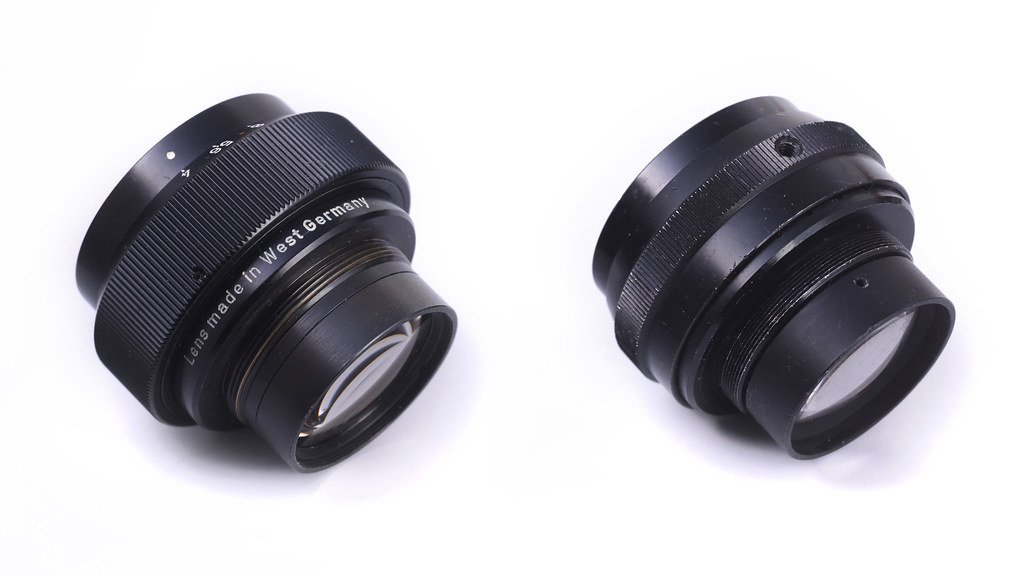
As you can see there's some resemblance, but it's not identical. The diameters are also very close but not completely the same. So while I initially thought there might have been some connection there, it's not unlikely that all of this is a coincidence.
Because the 'prototype' lens (which is in a really bad shape unfortunately) is missing its aperture blades, I found out that it's actually a f/2.8 lens wide open. This discovery planted the thought in my head, that it might be a prototype for the Macro-Yashinon 60/2.8 (also a 5/4 design). And indeed, the size, reflections, rendering - all of it seems to match.
The weird labeling still poses a lot of questions though:
- a red M=
- the blue N.J.K.
- the weird No. sign
- the single dots behind "Tominon." as well as "F4."
Do you have any idea what all of this could mean?
_________________
---
Manual lens enthusiast
https://www.flickr.com/photos/simple_joy/ |
|
| Back to top |
|
|
stevemark
Joined: 29 Apr 2011
Posts: 5426
Location: Switzerland
|
Posted: Tue Oct 17, 2023 1:41 am Post subject: |
|
Posted: Tue Oct 17, 2023 1:41 am Post subject: |
|
|
stevemark wrote:
| simple.joy wrote: |
Another couple of mostly unrelated questions about the Macro-Yashinon 60/2.8 lens to everyone here:
1.) What are your thoughts about the almost identically looking Mamiya Macro Sekor 60/2.8 and Rikoh Rikenon 60/2.8 Macro lenses? Do you think they all could have been made by Tomioka? Or have they more likely been licensed out to other manufacturers? If so, do you know if there are significant differences between them?
|
I have nothzing to contribute directly to your question.
However I was told, by a very reputable Swiss photographer and photo dealer, that back in the early 1980s he had visited a large Japanese third-party lens manufacturer (Tamron, as far as I remember). To his complete surprise he witnessed Macro lenses for all major Japanese photo companies being manufactured there, in the same large room.
In other words: At that point in time all the "original" Canon / Nikon / Pentax / Minolta etc macro lenses were manufactured at one single company (Tamron). I couldn't believe the story when I heard it, but said photographer was adamant, saying he had seen it with his own eyes.
Later on, around 2010, I met with four Sony representatives in Zurich, and then I got a glimpse at how the cooperation between different manufacturers in Japan works. Just for manufacturing the top-notch Sony lenses (A mount) there were at least five well known companies involved: Sony themselves, Zeiss, Cosina, Minolta and Tamron.
And look at the patents of the newest & fastest Nikkor lenses ... always some Minolta guys mentioned.
S
_________________
www.artaphot.ch |
|
| Back to top |
|
|
simple.joy
Joined: 30 May 2022
Posts: 945
|
Posted: Tue Oct 17, 2023 11:24 am Post subject: |
|
Posted: Tue Oct 17, 2023 11:24 am Post subject: |
|
|
simple.joy wrote:
| stevemark wrote: |
I have nothzing to contribute directly to your question.
However I was told, by a very reputable Swiss photographer and photo dealer, that back in the early 1980s he had visited a large Japanese third-party lens manufacturer (Tamron, as far as I remember). To his complete surprise he witnessed Macro lenses for all major Japanese photo companies being manufactured there, in the same large room.
In other words: At that point in time all the "original" Canon / Nikon / Pentax / Minolta etc macro lenses were manufactured at one single company (Tamron). I couldn't believe the story when I heard it, but said photographer was adamant, saying he had seen it with his own eyes.
Later on, around 2010, I met with four Sony representatives in Zurich, and then I got a glimpse at how the cooperation between different manufacturers in Japan works. Just for manufacturing the top-notch Sony lenses (A mount) there were at least five well known companies involved: Sony themselves, Zeiss, Cosina, Minolta and Tamron.
And look at the patents of the newest & fastest Nikkor lenses ... always some Minolta guys mentioned.
S |
Thank you very much for that story and insight! You certainly got a point there. I don't have any real knowledge on these 'behind the scenes' dealings myself but Robert OToole (of https://www.closeuphotography.com/) knows a vast amount of these stories and it's really surprising how many lenses were made by a completely different manufacturer or a number of them. Tamron certainly seems like a significant one who is behind a lot of lenses without their name on them. As I've mentioned in this thread:
http://forum.mflenses.com/odd-early-micro-tamron-70mm-f5-6-any-info-t40396.html
they even seem to have been behind the lens on a Leitz product (probably) in the late 1960s. I think that this practice got way more common though in the 1980s all around the world and is until today. I don't think Tomioka was ever in the league the really big ones like Tamron or Cosina are in nowadays, but they seem to have had a lot of influence for a company which a.) wasn't all that big and b.) was only independent until 1968... It is hard to judge how well known the brand was in Japan when Yashica bought them and why they chose to keep their name/lens names around, but its somewhat surprising and interesting to see (and thus probably also to speculate 😅).
_________________
---
Manual lens enthusiast
https://www.flickr.com/photos/simple_joy/ |
|
| Back to top |
|
|
Pancolart

Joined: 04 Feb 2008
Posts: 3710
Location: Slovenia, EU
Expire: 2013-11-18
|
Posted: Wed Oct 18, 2023 7:21 am Post subject: |
|
Posted: Wed Oct 18, 2023 7:21 am Post subject: |
|
|
Pancolart wrote:
Indeed great story of benefits of cooperation. And even without the communist background. This kinda closes the story of Tomioka for me.
_________________
---------------------------------
The Peculiar Apparatus Of Victorian Steampunk Photography: 100+ Genuine Steampunk Camera Designs https://www.amazon.com/dp/B0B92829NS |
|
| Back to top |
|
|
ZuikosHexanonsandVivitars


Joined: 03 Nov 2021
Posts: 263
Location: Austria
|
Posted: Wed Oct 18, 2023 3:15 pm Post subject: |
|
Posted: Wed Oct 18, 2023 3:15 pm Post subject: |
|
|
ZuikosHexanonsandVivitars wrote:
Reading this topic, what comes to my mind is that "mindful treatment of intellectual property rights" in Japan in the 60s and 70s probably meant, be mindful of any new product on the market from your competitors, buy it the next day, analyse it, take it apart, put it back together, analyse it some more and see what you can make use of that in your own products. That doesn´t necessarily mean they were copying 1:1, but probably close enough.
Don´t misunderstand me please. That wasn´t necessarily a bad thing, and probably just the innovative boost needed to sweep the Japanese optical industry to the top.
I just want to say, if anyone of us has two identical looking lenses in front of them, even if they look identical down to the last screw, inside or outside, that doesn´t necessarily mean they really are. You wouldn´t recognize those miniscule differences, I dare say. But it was apparently enough to avoid battles over IPR and patents.
The people who were really in the know back then are long since retired or deceased, and considering the loyalty these people held or still hold high to their old companies, very little information would come anyway. From the few information in written, very little can be concluded either. I assume it will remain speculation, regardless how hard one looks.
_________________
Cheers, Gerhard |
|
| Back to top |
|
|
stevemark
Joined: 29 Apr 2011
Posts: 5426
Location: Switzerland
|
Posted: Wed Oct 18, 2023 4:56 pm Post subject: |
|
Posted: Wed Oct 18, 2023 4:56 pm Post subject: |
|
|
stevemark wrote:
| ZuikosHexanonsandVivitars wrote: |
| Reading this topic, what comes to my mind is that "mindful treatment of intellectual property rights" in Japan in the 60s and 70s probably meant, be mindful of any new product on the market from your competitors, buy it the next day, analyse it, take it apart, put it back together, analyse it some more and see what you can make use of that in your own products. That doesn´t necessarily mean they were copying 1:1, but probably close enough. |
Certainly. Look at the Minolta 4.5/21mm for instance:
http://www.artaphot.ch/minolta-sr/objektive/142-minolta-21mm-f45
VERY similar but not identical to the classical Zeiss Biogon 4.5/21mm, patented about twelve years earlier in Switzerland (yep, in Switzerland first - Bertele back then was working for Wild Heerbrugg, licensing his Biogon to Zeiss):
http://artaphot.ch/images/Technik/Zeiss/Biogon/FS144_History_ZeissBiogon_150dpi.pdf
The double front lens clearly was protected by Bertele's patent, and Minolta seems to have missed that. One year later the original 4.5/21mm was replaced by a 4/21mm ... without double front lens ...:
http://www.artaphot.ch/minolta-sr/objektive/141-minolta-21mm-f4
Similarly, the Konica Hexagon AR 4/21mm lens section looks suspiciuosly similar to the Zeiss Jena 4/20mm:
http://www.artaphot.ch/konica-ar/objektive/379-konica-hexanon-21mm-f4
I'm sure there are dozens of similar cases ...
| ZuikosHexanonsandVivitars wrote: |
Don´t misunderstand me please. That wasn´t necessarily a bad thing, and probably just the innovative boost needed to sweep the Japanese optical industry to the top.
|
If the German photo industry would have had similar interest in the Japanese products from the 1960s, they might have survived ...
S
_________________
www.artaphot.ch |
|
| Back to top |
|
|
Oldhand

Joined: 01 Apr 2013
Posts: 6014
Location: Mid North Coast NSW - Australia
|
Posted: Wed Oct 18, 2023 9:24 pm Post subject: |
|
Posted: Wed Oct 18, 2023 9:24 pm Post subject: |
|
|
Oldhand wrote:
| ZuikosHexanonsandVivitars wrote: |
Reading this topic, what comes to my mind is that "mindful treatment of intellectual property rights" in Japan in the 60s and 70s probably meant, be mindful of any new product on the market from your competitors, buy it the next day, analyse it, take it apart, put it back together, analyse it some more and see what you can make use of that in your own products. That doesn´t necessarily mean they were copying 1:1, but probably close enough.
Don´t misunderstand me please. That wasn´t necessarily a bad thing, and probably just the innovative boost needed to sweep the Japanese optical industry to the top.
I just want to say, if anyone of us has two identical looking lenses in front of them, even if they look identical down to the last screw, inside or outside, that doesn´t necessarily mean they really are. You wouldn´t recognize those miniscule differences, I dare say. But it was apparently enough to avoid battles over IPR and patents.
The people who were really in the know back then are long since retired or deceased, and considering the loyalty these people held or still hold high to their old companies, very little information would come anyway. From the few information in written, very little can be concluded either. I assume it will remain speculation, regardless how hard one looks. |
Very well said - and an astute comment
Tom |
|
| Back to top |
|
|
ZuikosHexanonsandVivitars
Joined: 03 Nov 2021
Posts: 263
Location: Austria
|
Posted: Thu Oct 19, 2023 12:59 pm Post subject: |
|
Posted: Thu Oct 19, 2023 12:59 pm Post subject: |
|
|
ZuikosHexanonsandVivitars wrote:
Hi Stephan, that one is really an interesting read. Very well explained. Thank you!
| Oldhand wrote: |
Very well said - and an astute comment
Tom |
Thank you for the kind words, Tom.
Btw, to that apparent common practice of innovation transfer:
No one can keep you from buying a product of your competitor and have a good look at it. Industrial espionage, however, is a whole other thing. It probably means to bribe an intern in the right department of your competitor to obtain for you production documentation, scientific background papers, break and enter their factory compound, take images of assembly lines and all papers that can be found, steal raw material samples, all that.
And I don´t think that happened.
Because despite all their complicated and cunning designs, lenses back in that time, strictly analog, couldn´t keep a secret from a seasoned specialist determined to find that secret. And once you found what you were looking for, you took a couple of days or weeks at the patent office to study any paper from your fellow competitors to learn what they aimed to protect, and then find a way around it while still getting what you want to achieve. If I´m not mistaken, that´s technically even legal.
And as Stephan says above, if the Germans were only interested in Japanese optics...
That´s exactly the point. No company can be innovative on the long run while only stewing in their own brew. Often, most valuable innovation, inspiration and fresh ideas come from outside.
_________________
Cheers, Gerhard |
|
| Back to top |
|
|
simple.joy
Joined: 30 May 2022
Posts: 945
|
Posted: Fri Nov 03, 2023 8:58 am Post subject: |
|
Posted: Fri Nov 03, 2023 8:58 am Post subject: |
|
|
simple.joy wrote:
If you don't mind, I've got one more thing I would ask for some help with:
I've prepared a (somewhat sloppy) timeline for the article and because I might be missing some things I would really appreciate it, if you could take a look and let me know what's missing/wrong/redundant or if you have any ideas how to group things differently etc.

As mentioned before I'm only mentioning taking lenses to give some context, but because it's not a big part of the article, I want to keep those to a minimum (not go into the distinctions of when or what was produced for whom), so the big block of OEM/3rd party lenses (are those terms correct here?) is an attempt at that and does of course omit a lot of relevant distinctions etc.
There are also a couple of assumptions in there (for example the transfer of lens production to Cosina, which D1N0 among others mentioned etc.), so where it won't be possible to give a clear answer or point in time, I'm going to mention that in the article.
_________________
---
Manual lens enthusiast
https://www.flickr.com/photos/simple_joy/ |
|
| Back to top |
|
|
alex_d
Joined: 19 Jan 2019
Posts: 553
|
Posted: Fri Nov 03, 2023 9:56 am Post subject: |
|
Posted: Fri Nov 03, 2023 9:56 am Post subject: |
|
|
alex_d wrote:
simplejoy, what is the source of informations for this tomioka history diagram ? |
|
| Back to top |
|
|
D1N0
Joined: 07 Aug 2012
Posts: 2724
|
Posted: Fri Nov 03, 2023 9:58 am Post subject: |
|
Posted: Fri Nov 03, 2023 9:58 am Post subject: |
|
|
D1N0 wrote:
Yashica was bought by Kyocera in it's entirety, Tomioka was part of the package. Yashica was also making Contax http://camera-wiki.org/wiki/Contax_(Yashica/Kyocera)
They even launched a line of very clunky looking AF SLR's I don't know anything about the lenses for them since they fall out of my mf-scope but I am guessing they were working with Cosina.
_________________
pentaxian |
|
| Back to top |
|
|
simple.joy
Joined: 30 May 2022
Posts: 945
|
Posted: Fri Nov 03, 2023 11:15 am Post subject: |
|
Posted: Fri Nov 03, 2023 11:15 am Post subject: |
|
|
simple.joy wrote:
| alex_d wrote: |
| simplejoy, what is the source of informations for this tomioka history diagram ? |
As you probably know there is a lack of sources on Tomioka, so I got it from all across the internet, particularly:
http://camera-wiki.org/wiki/Tomioka
https://en.wikipedia.org/wiki/Yashica
https://yashica.boards.net/
https://yashicasailorboy.com/
https://global.kyocera.com/prdct/optec/history.html
https://www.closeuphotography.com/tominon-e36-lens
https://www.digicamclub.de/forum.php
https://www.photocornucopia.com/1061.html
- a magazine from 1938 from Japan, which I acquired
- some manuals and ads in the Internet Archive
- some of the sources mentioned here in this thread
These are just a couple. I'll mention and/or cite all of them in the full article in the appropriate places.
As stated above, there's a lot of uncertainty, estimation and guesswork in there, so please take everything with a grain of salt for now!
| D1N0 wrote: |
Yashica was bought by Kyocera in it's entirety, Tomioka was part of the package. Yashica was also making Contax http://camera-wiki.org/wiki/Contax_(Yashica/Kyocera)
They even launched a line of very clunky looking AF SLR's I don't know anything about the lenses for them since they fall out of my mf-scope but I am guessing they were working with Cosina. |
I'm aware that Tomioka was bought by Kyocera with Yashica, but did they continue their cooperation with Zeiss for a long time after the acquisition? I have to admit that I'm not familiar with Contax... I thought lens production for the Contax line might have changed over to Cosina (and perhaps also continued in Germany?) as well pretty quickly and Tomioka was given new tasks within the Kyocera company.
_________________
---
Manual lens enthusiast
https://www.flickr.com/photos/simple_joy/ |
|
| Back to top |
|
|
simple.joy
Joined: 30 May 2022
Posts: 945
|
Posted: Fri Nov 03, 2023 11:27 am Post subject: |
|
Posted: Fri Nov 03, 2023 11:27 am Post subject: |
|
|
simple.joy wrote:
| D1N0 wrote: |
They even launched a line of very clunky looking AF SLR's I don't know anything about the lenses for them since they fall out of my mf-scope but I am guessing they were working with Cosina. |
I've heard that the Kyocera Yashica AF Macro 60 mm f/2.8 was actually a derivative of the Macro-Yashinon 60 mm f/2.8 with improved optics, so despite its (plasticky) look, it apparently produces really nice images. No idea if Tomioka was involved in the modernization of the lens design though. Could have been Cosina or someone else as well...
https://www.digicamclub.de/showthread.php?t=19481
https://www.flickr.com/photos/49576306@N08/albums/72157656759909162/with/19671066493
Seems to be pretty good, so never judge a book by its cover. I think the main problem is the mount, or is there some kind of adapter for these lenses?
EDIT: There seem to be Fotodiox adapters for Yashica AF but they're not cheap... (https://fotodioxpro.com/search?type=product&q=yashica+af)
_________________
---
Manual lens enthusiast
https://www.flickr.com/photos/simple_joy/ |
|
| Back to top |
|
|
|
|