| View previous topic :: View next topic |
| Author |
Message |
aly324

Joined: 11 May 2013
Posts: 56
Location: Lanzhou, China
|
 Posted: Sat Jun 22, 2013 6:20 pm Post subject: Contax and Contarex lenses -- specific general (!) questions |
|
Posted: Sat Jun 22, 2013 6:20 pm Post subject: Contax and Contarex lenses -- specific general (!) questions |
|
|
aly324 wrote:
After about 10 years of avid photography with autofocus zooms, I caught the manual lenses bug a few months ago and began using Contax Zeiss primes. From there I became interested in Contarex glass. All this time I've been reading a lot about these lenses online (I am aware of physical publications on them but don't have access to them currently), but some questions remain. Thank you in advance for your attention and help!
1) I own the Contax Planar 35/1.4 AEG and 50/1.4 AEJ (edit: not AEG... AEJ only) and use them with my NEX-7. I enjoy the detail and the vibrancy of the colors they produce tremendously, but I'm bothered by the chromatic aberration at open apertures and as well by the quite noticeable barrel distortion, since architectural and geometric framing figures in many of my photos. (I usually use the Speed Booster, which I'm aware adds its own distortion and possibly CA.) Whereas the Contarex 35/2 and 50/2, judging from the scant sample photos online, appear to be very well-corrected for both CA and distortion. Are they?
Orio here (paraphrasing Erwin Puts, http://forum.mflenses.com/erwin-puts-on-contarex-lenses-t32255.html) wrote that in Contarex lenses "the control of astigmatism and field flatness is the priority over the overall contrast." I have only a superficial understanding of both but suspect they bear some relation to CA and distortion. Is it fair to generalize that there was a trend in lens design to prioritize resolution and contrast over optical aberrations circa 1970? If so, why?
2) I often feel constrained by the MFD's of the 50/1.4 and 85/1.4, and was perplexed and jealous to learn that the Contarex f/2 lenses all focus closer than their newer, faster counterparts. Now what was the optical compromise here? Do wider maximum apertures render it more difficult to maintain close focus distance? And, again to pose this question historically--did lens makers deprioritize MFD around this time? Is it because they started to make dedicated macro lenses? Or did people just became less interested in macro?
3) A thread here (http://forum.mflenses.com/1968-contarex-super---50-2-planar-quotcamera-35quot-rev-t45838.html) cites a 1968 magazine that gives the "resolution figures" of the Contarex Planar 50/2. The figures range from 40 to 80, with half I take it "maxing out" at 80. I want to know what metrics is being used here. Is it a percentage? Or is it some absolute measure like lines resolved per square area? How would one translate this '80' into today's terms?
4) Why is the current Distagon 35/1.4 (ZF, ZE, etc) so much heavier than the Rollei and Contax predecessors? What are the substantive optical changes?
5) Do RF and SLR Zeiss lenses typically share the same optical formula? For example, is the Contax RF Sonnar 85/2 (and its Soviet derivatives) essentially the same as the Contarex 85/2, but proportionately smaller?
Thank you and with apologies for ignorance!
Last edited by aly324 on Sun Jun 23, 2013 2:43 am; edited 1 time in total |
|
| Back to top |
|
 |
Lightshow


Joined: 04 Nov 2011
Posts: 3666
Location: Calgary
|
Posted: Sat Jun 22, 2013 8:57 pm Post subject: |
|
Posted: Sat Jun 22, 2013 8:57 pm Post subject: |
|
|
Lightshow wrote:
4) The current Z* line use much more metal then they did in the 70's-90's, plastic was used to cut manufacturing costs as much as possible, everyone did it to some degree. I'm not too sure what changes to the optics took place.
5) RF & SLR lens designs 50mm and shorter are typically very different, mostly due to the registration differences and having to clear the mirror on SLR's so they had to come up with a design to increase the distance of the rear elements away from the mirror, it took a few years but that hurdle was passed.
http://en.wikipedia.org/wiki/Ang%C3%A9nieux_retrofocus
http://en.wikipedia.org/wiki/History_of_photographic_lens_design
_________________
A Manual Focus Junky...
One photographers junk lens is an artists favorite tool.
My lens list
http://www.flickr.com/photos/lightshow-photography/ |
|
| Back to top |
|
|
cambug
Joined: 06 Jun 2010
Posts: 91
|
Posted: Sun Jun 23, 2013 12:41 am Post subject: |
|
Posted: Sun Jun 23, 2013 12:41 am Post subject: |
|
|
cambug wrote:
This is my impression, net necessarily a debate or argument of the questions.
1. The AEG version of 50mm f1.4 Planar for C/Y Contax is a very rare find of the lens, congrat if that is the one you have. The comparison of the two series is questionable, with speed booster used on Contax lens and no real sample from Contarex lens, different subject matter and lighting conditions, a valid concludion can hardly be drawn. A while back at a show, have seen some samples shown by Zeiss of pictures taken by a new 55mm F1.5 Distagon ( notice that this is not a Planar ) of the ZE / ZF series, they emphazesed the performance at full opening, high contrast, low CA, nice bokeh. The usual f1.4 Planar are of 7 elements in 5 groups, this Distagon with 11 elements, not sure how many groups. At a price point of $4k, and a standard lens focal length, it is interesting to see what the sales would be.
2. There must be compromise in lens design, otherwise we don't ne-d macro lenses, shorter minimum focusing distance sure could provide some convenience. The Contarex version of the 50mm f4 S-Planar does NOT allow infinity focus, that may be their way to show no compromise in quality, that can also be the reason why a Super Electronic kit was more expensive that a Hasselblad kit in early 70's. If close focusing is very important, without large investment, those Zeiss Jena lenses are know to provide very close focusing distance and a decent picture quality.
4. The environment concerns rendered some type of materials are not allowed to be used on making optical glass. Thus the old type of glass with required properties may no longer be available for a particular lens formulation, modification of design may be inevitable. It was said that the MTF graph of the new 38mm Biogon for Hasselblad SWC was not as good as the old one, because of change of glass type available, a good or bad outcome to the photographer? |
|
| Back to top |
|
|
fermy


Joined: 17 Feb 2012
Posts: 1974
|
Posted: Sun Jun 23, 2013 2:31 am Post subject: |
|
Posted: Sun Jun 23, 2013 2:31 am Post subject: |
|
|
fermy wrote:
One obvious change from Contax lenses to current Zeiss lines, is that modern lenses use aspherical elements, Contax lenses are all conventional spherical optics.
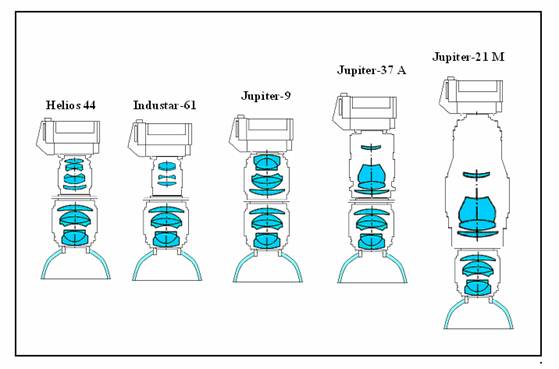
Contarex Sonnar is very close to the original Sonnar from 1932 and Jupiter-9.


_________________
Many lenses and some film bodies for sale here: http://forum.mflenses.com/canon-fd-minolta-md-c-mounts-m42-pentax-and-more-t50465.html
Flickr http://www.flickr.com/photos/96060788@N06/ |
|
| Back to top |
|
|
|
|
|
You cannot post new topics in this forum
You cannot reply to topics in this forum
You cannot edit your posts in this forum
You cannot delete your posts in this forum
You cannot vote in polls in this forum
|