| View previous topic :: View next topic |
| Author |
Message |
iangreenhalgh1


Joined: 18 Mar 2011
Posts: 15679
Expire: 2014-01-07
|
 Posted: Sat Aug 27, 2011 2:38 am Post subject: Kodak Ektar f2 45mm |
|
Posted: Sat Aug 27, 2011 2:38 am Post subject: Kodak Ektar f2 45mm |
|
|
iangreenhalgh1 wrote:
Hi folks
I picked up this old and unusual lens on ebay for next to nothing.

Hard to find any info, but the wikipedia page on double gauss lenses has this snippet:
| Quote: |
| Early Double Gauss permutations for 35mm cameras included the Kodak Ektar 45mm f/2 on the Kodak Bantam Special (1936, USA) |
Clearly my lens isn't from a Bantam Special but it may be optically the same, just in a different mount.
I also found this info:
| Quote: |
Kodak Ektar 2/45 (for Bantam Special)
6 elements in 4 groups, covers 28x40mm negatives |
There is no focusing mount, just an aperture ring, the mount is heavy brass, the lens comes apart easily and I will need to clean it as there is a lot of dust and crap inside and the rear element group is a bit cloudy, needs a thorough clean but luckily there seems to be no fungus at all and with a good clean it should be almost perfect, optically.
I found a bit of interesting info on Ektar lenses:
| Quote: |
Ektar was used by Kodak as a trade name for its premium lenses. There were a number of generic designs used for them. Ektars were all very high quality lenses. The ones made for press and view cameras were mostly Tessar types. Exceptions are the Wide Field Ektars, which are four element air-spaced lenses of the "Double Gause" type, and the 203mm f/7.7 Ektar which is a four-element air-spaced Dialye type, made slightly non-symetrical to improve its correction for distant objects.
All of these lenses are completely corrected for lateral color and were intended for color photography. Some Ektars were coated as early as 1940. These include the series of f/6.3 lenses marked "Eastman Ektar", which are the predicessors of the Commerical Ektar series. The early coatings were soft and applied only to inside surfaces.
Other early coated Ektars were the lenses made for the Ektra camera and for the Medallist. Other Ektar lenses were not coated until after about 1946.
Kodak had a very advanced glass plant and made their own optical glass. They developed commercially the rare-earth glasses discovered at the National Bureau of Standards and were one of the first manufacturers to use Lanthanum Crown glass.
Ektars are also among the earliest lenses to be cemented with thermo-setting synthetic adhesives rather than the traditional Canada Balsam.
Generally, an Ektar in good condition will have excellent performance even by current standards. Kodak quality control after about 1938, when Rudolph Kingslake took over the optical department, was excellent. |
So what I have here is a premium lens from the 1940s in an unusual brass mount, no idea what it is from, possibly something military given the vintage?
I will give this a thorough clean and polish then figure out a focussing mount for it.
Anyone got any idea what type of performance and rendering this lens will have? I'm guessing it will be similar to the Zeiss Biotar 2/58 so it will be interesting to compare it to my Helios 44-2.
_________________
I don't care who designed it, who made it or what country it comes from - I just enjoy using it! |
|
| Back to top |
|
 |
luisalegria

Joined: 07 Mar 2008
Posts: 6602
Location: San Francisco, USA
Expire: 2018-01-18
|
Posted: Sat Aug 27, 2011 2:53 am Post subject: |
|
Posted: Sat Aug 27, 2011 2:53 am Post subject: |
|
|
luisalegria wrote:
No aperture ?
Could be a projection lens.
_________________
I like Pentax DSLR's, Exaktas, M42 bodies of all kinds, strange and cheap Japanese lenses, and am dabbling in medium format/Speed Graphic work. |
|
| Back to top |
|
|
iangreenhalgh1
Joined: 18 Mar 2011
Posts: 15679
Expire: 2014-01-07
|
Posted: Sat Aug 27, 2011 2:54 am Post subject: |
|
Posted: Sat Aug 27, 2011 2:54 am Post subject: |
|
|
iangreenhalgh1 wrote:
I found a similar Ektar here:
http://www.flickriver.com/photos/jore0902/sets/72157617908787023/
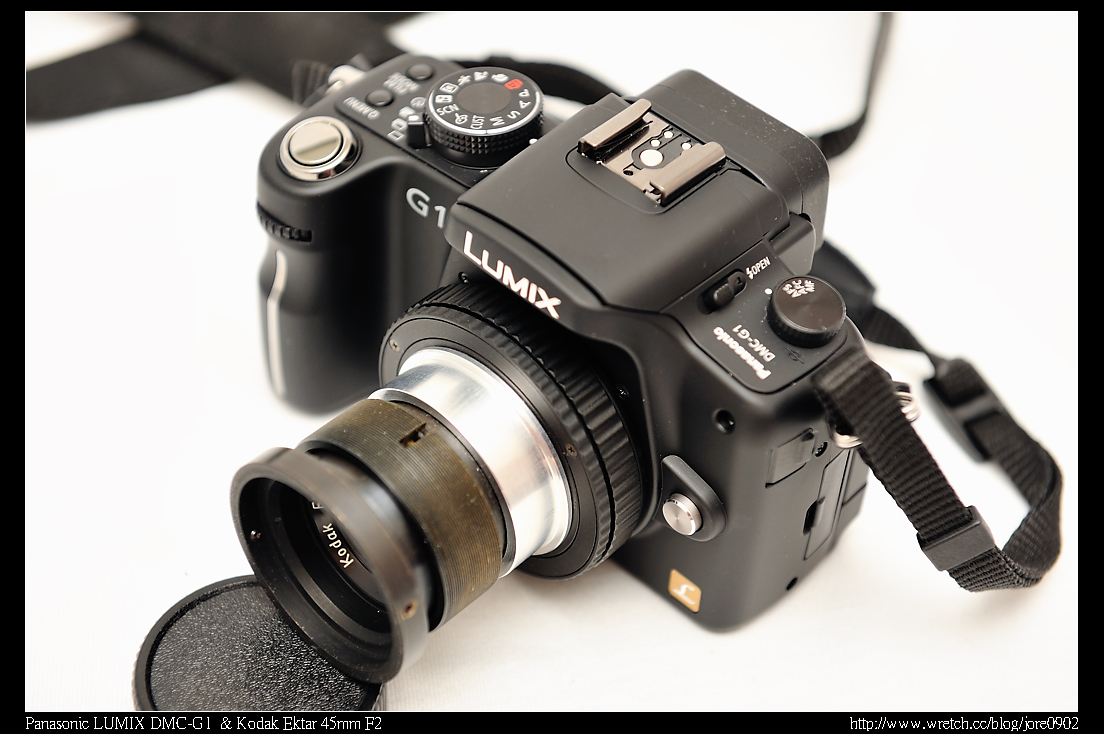
Sadly there are't any sample pics taken with the lens.
_________________
I don't care who designed it, who made it or what country it comes from - I just enjoy using it! |
|
| Back to top |
|
|
iangreenhalgh1
Joined: 18 Mar 2011
Posts: 15679
Expire: 2014-01-07
|
Posted: Sat Aug 27, 2011 3:00 am Post subject: |
|
Posted: Sat Aug 27, 2011 3:00 am Post subject: |
|
|
iangreenhalgh1 wrote:
| luisalegria wrote: |
No aperture ?
Could be a projection lens. |
It has an aperture, I am certain it's the 6 elements in 4 groups double gauss lens, same as the Bantam Special had, but the unusual mounting confuses me.
_________________
I don't care who designed it, who made it or what country it comes from - I just enjoy using it! |
|
| Back to top |
|
|
Kathmandu


Joined: 09 Dec 2009
Posts: 1479
Location: (Kathmandu,Nepal. Currently)Pacific Northwest, USA
Expire: 2012-04-08
|
|
| Back to top |
|
|
iangreenhalgh1
Joined: 18 Mar 2011
Posts: 15679
Expire: 2014-01-07
|
Posted: Sat Aug 27, 2011 3:17 am Post subject: |
|
Posted: Sat Aug 27, 2011 3:17 am Post subject: |
|
|
iangreenhalgh1 wrote:
Nice lenses. The Ektars started in 1939 and had only soft coatings on the inner elements, the L in a circle indicates hard coatings and began in 1946, mine lacks that mark so I reckon it's from the 39-46 time frame.
That lens mounted on the G1 is clearly the same as mine, it has had the large brass mount plate removed, you can see the three screw holes where it was affixed.
I wonder what a wartime US made lens is doing in England (I bought it from a UK seller) in the first place? I suspect it came here as part of some military equipment although god knows what!
Anyone know what cameras were used by the US Army Signal Corps and the US Army Air Corps during WW2?
_________________
I don't care who designed it, who made it or what country it comes from - I just enjoy using it! |
|
| Back to top |
|
|
iangreenhalgh1
Joined: 18 Mar 2011
Posts: 15679
Expire: 2014-01-07
|
Posted: Tue Jul 04, 2017 9:52 am Post subject: |
|
Posted: Tue Jul 04, 2017 9:52 am Post subject: |
|
|
iangreenhalgh1 wrote:
Reviving a 6 year old thread because I found this lens on my shelf and decided to finally clean it. It cleaned up nice but the haze on the back element is actually lots of fine scratches.
The serial number is ER357, making it a 1945 production.
I think it has come from some sort of military equipment.
It has 15 aperture blades and is uncoated.
I'll mount it on my NEX and see how it does.
_________________
I don't care who designed it, who made it or what country it comes from - I just enjoy using it! |
|
| Back to top |
|
|
Mr G

Joined: 27 Jan 2014
Posts: 187
Location: London & Essex
|
Posted: Tue Jul 04, 2017 1:50 pm Post subject: |
|
Posted: Tue Jul 04, 2017 1:50 pm Post subject: |
|
|
Mr G wrote:
Hi guys, i've got an m mount Ektar somewhere, I'll dig it out later and post a pic, maybe someone knows if they are adaptable.
_________________
EVEN A BLIND SQUIRREL FINDS A NUT NOW AND THEN! |
|
| Back to top |
|
|
uddhava

Joined: 22 Aug 2012
Posts: 3079
Location: Hungary
Expire: 2021-06-21
|
Posted: Tue Jul 04, 2017 2:31 pm Post subject: |
|
Posted: Tue Jul 04, 2017 2:31 pm Post subject: |
|
|
uddhava wrote:
Hope you get some nice results.
I am curious to see some photos. |
|
| Back to top |
|
|
Lightshow

Joined: 04 Nov 2011
Posts: 3666
Location: Calgary
|
Posted: Tue Jul 04, 2017 6:29 pm Post subject: |
|
Posted: Tue Jul 04, 2017 6:29 pm Post subject: |
|
|
Lightshow wrote:
| iangreenhalgh1 wrote: |
Nice lenses. The Ektars started in 1939 and had only soft coatings on the inner elements, the L in a circle indicates hard coatings and began in 1946, mine lacks that mark so I reckon it's from the 39-46 time frame.
That lens mounted on the G1 is clearly the same as mine, it has had the large brass mount plate removed, you can see the three screw holes where it was affixed.
I wonder what a wartime US made lens is doing in England (I bought it from a UK seller) in the first place? I suspect it came here as part of some military equipment although god knows what!
Anyone know what cameras were used by the US Army Signal Corps and the US Army Air Corps during WW2? |
The date codes for those interested.
http://www.bnphoto.org/bnphoto/KodakID.htm
Found this site while doing a search https://kodakery.com/ thought some might enjoy it.
_________________
A Manual Focus Junky...
One photographers junk lens is an artists favorite tool.
My lens list
http://www.flickr.com/photos/lightshow-photography/ |
|
| Back to top |
|
|
iangreenhalgh1
Joined: 18 Mar 2011
Posts: 15679
Expire: 2014-01-07
|
Posted: Wed Jul 05, 2017 4:21 am Post subject: |
|
Posted: Wed Jul 05, 2017 4:21 am Post subject: |
|
|
iangreenhalgh1 wrote:
That is an interesting site, cheers.
I tried the lens out briefly and it's not good, those fine scratches have ruined it, the image formed is a glowy, blurry mess.
I'll post a couple of samples later.
_________________
I don't care who designed it, who made it or what country it comes from - I just enjoy using it! |
|
| Back to top |
|
|
|
|
|
You cannot post new topics in this forum
You cannot reply to topics in this forum
You cannot edit your posts in this forum
You cannot delete your posts in this forum
You cannot vote in polls in this forum
|