| View previous topic :: View next topic |
| Author |
Message |
F16SUNSHINE


Joined: 20 Aug 2007
Posts: 5486
Location: Left Coast
Expire: 2011-11-18
|
 Posted: Thu Feb 10, 2011 9:28 pm Post subject: Jet Graphic |
|
Posted: Thu Feb 10, 2011 9:28 pm Post subject: Jet Graphic |
|
|
F16SUNSHINE wrote:
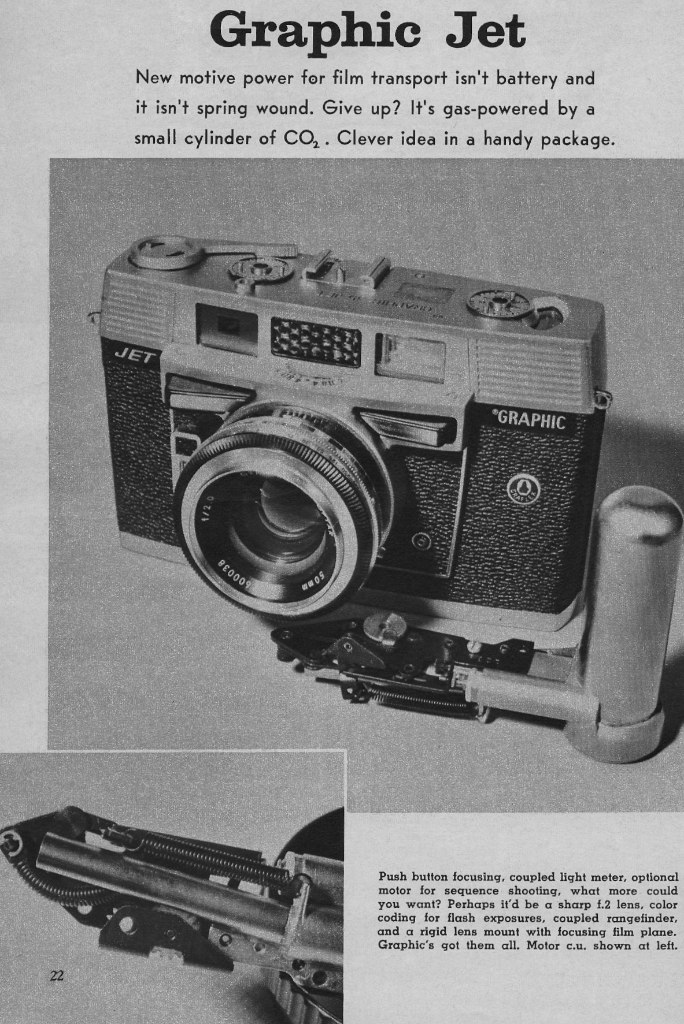
Rigid lens mount with focusing film plane.
Co2 powered motor drive. Anyone ever see one of these?
 |
|
| Back to top |
|
 |
Nesster

Joined: 24 Apr 2008
Posts: 5883
Location: NJ, USA
Expire: 2014-02-20
|
Posted: Thu Feb 10, 2011 9:48 pm Post subject: |
|
Posted: Thu Feb 10, 2011 9:48 pm Post subject: |
|
|
Nesster wrote:
certainly is a strange beast
_________________
-Jussi
Camera photos
Print Photographica
|
|
| Back to top |
|
|
luisalegria

Joined: 07 Mar 2008
Posts: 6602
Location: San Francisco, USA
Expire: 2018-01-18
|
Posted: Fri Feb 11, 2011 2:20 am Post subject: |
|
Posted: Fri Feb 11, 2011 2:20 am Post subject: |
|
|
luisalegria wrote:
Forget the CO2 motor drive accessory - OK, that parts hard to forget, but -
The "push button" feature plus other design details point to this being a derivative of the Graphic 35, so US-made.
What a camera ! This would make it one of the most modern cameras of the 1950's, and one of the most interesting cameras ever made in the US. The film-plane focus alone would make it special.
Any collector would jump on one of these.
I've never seen one or even heard of it. I wonder if these things were ever produced at all in fact. Its probably from around the time Graflex stopped making their consumer cameras and just started reselling Japanese models.
_________________
I like Pentax DSLR's, Exaktas, M42 bodies of all kinds, strange and cheap Japanese lenses, and am dabbling in medium format/Speed Graphic work. |
|
| Back to top |
|
|
F16SUNSHINE
Joined: 20 Aug 2007
Posts: 5486
Location: Left Coast
Expire: 2011-11-18
|
Posted: Fri Feb 11, 2011 2:32 am Post subject: |
|
Posted: Fri Feb 11, 2011 2:32 am Post subject: |
|
|
F16SUNSHINE wrote:
This is out of a "Good photographers 35mm handbook" published in 1960.
If you guys like I'll scan the review and post it.
It's sorta quaint and at the same time... I would love to have one. Sans winder for me thanks  |
|
| Back to top |
|
|
luisalegria
Joined: 07 Mar 2008
Posts: 6602
Location: San Francisco, USA
Expire: 2018-01-18
|
Posted: Fri Feb 11, 2011 3:57 am Post subject: |
|
Posted: Fri Feb 11, 2011 3:57 am Post subject: |
|
|
luisalegria wrote:
OK, it does indeed exist, and it seems is not all that rare -
http://www.foundvalue.com/photo/vintage-graflex-jet-graphic-35-camera-2050mm-nr-34150
Very interesting indeed, thank you. Now to look for one !
_________________
I like Pentax DSLR's, Exaktas, M42 bodies of all kinds, strange and cheap Japanese lenses, and am dabbling in medium format/Speed Graphic work. |
|
| Back to top |
|
|
TBaker


Joined: 02 Dec 2009
Posts: 344
Location: Canada
|
Posted: Fri Feb 11, 2011 11:06 am Post subject: |
|
Posted: Fri Feb 11, 2011 11:06 am Post subject: |
|
|
TBaker wrote:
Wow! Talk about a blast from the past. |
|
| Back to top |
|
|
Sevo

Joined: 22 Aug 2008
Posts: 1189
Location: Frankfurt, Germany
Expire: 2012-12-03
|
Posted: Fri Feb 11, 2011 12:01 pm Post subject: |
|
Posted: Fri Feb 11, 2011 12:01 pm Post subject: |
|
|
Sevo wrote:
| luisalegria wrote: |
The "push button" feature plus other design details point to this being a derivative of the Graphic 35, so US-made.
|
It was a bit of a mess - conceived in the US extending a previous electric-driven German (Iloca) design, contract built by Kowa in Japan. None of the contributors assumed responsibility for the resulting freak...
_________________
Sevo |
|
| Back to top |
|
|
Nesster
Joined: 24 Apr 2008
Posts: 5883
Location: NJ, USA
Expire: 2014-02-20
|
Posted: Fri Feb 11, 2011 2:18 pm Post subject: |
|
Posted: Fri Feb 11, 2011 2:18 pm Post subject: |
|
|
Nesster wrote:
Here's its story:
http://graflex.org/GHQ/GHQ-13-1.pdf
You need to scroll all the way past some other fascinating stuff to page 7... the camera was made by Kowa, the CO2 bit by Graflex and the two didn't mate well, and additionally there were problems with the O rings... this caused stress between Kowa and Graflex; only two runs of the CO2 version were ever made.
_________________
-Jussi
Camera photos
Print Photographica
|
|
| Back to top |
|
|
cooltouch

Joined: 15 Jan 2009
Posts: 9096
Location: Houston, Texas
|
Posted: Fri Feb 11, 2011 5:38 pm Post subject: |
|
Posted: Fri Feb 11, 2011 5:38 pm Post subject: |
|
|
cooltouch wrote:
Fascinating, really. Too bad they didn't gut it out and work through the development problems.
You know, this reminds me of another pneumatically-actuated camera I saw on eBay -- must have been a couple years ago or so. Very rare, the seller wanted an obscene amount of money for it. Don't recall the name, and I haven't had any luck finding info about it doing web searches. But what it did was use pneumatics to "automatically" stop down the lens aperture. Had tiny little hoses and the whole deal. Wish I could find a link to more info about it.
_________________
Michael
My Gear List: http://michaelmcbroom.com/photo/gear.html
My Gallery: http://michaelmcbroom.com/gallery3/index.php/
My Flickr Page: https://www.flickr.com/photos/11308754@N08/albums
My Music: https://soundcloud.com/michaelmcbroom/albums
My Blog: http://michaelmcbroom.com/blogistan/ |
|
| Back to top |
|
|
Sevo
Joined: 22 Aug 2008
Posts: 1189
Location: Frankfurt, Germany
Expire: 2012-12-03
|
Posted: Fri Feb 11, 2011 6:50 pm Post subject: |
|
Posted: Fri Feb 11, 2011 6:50 pm Post subject: |
|
|
Sevo wrote:
| cooltouch wrote: |
You know, this reminds me of another pneumatically-actuated camera I saw on eBay -- must have been a couple years ago or so. Very rare, the seller wanted an obscene amount of money for it. Don't recall the name, and I haven't had any luck finding info about it doing web searches. But what it did was use pneumatics to "automatically" stop down the lens aperture. Had tiny little hoses and the whole deal. Wish I could find a link to more info about it. |
Most likely the Agfa Automatic 66, which was the automatic version of the Super Isolette and first portable AE camera. It is aperture priority though, regulating the time with pneumatics. It used a electromagnetic valve driven by the selenium cell to regulate the air flow (and hence timing) on a air-brake type shutter. Similar Compound shutters were made for over eighty years and are still popular among LF'ers for their reliability, so that was not that silly a idea as it might seem. Unfortunately they failed to put the valve into the shutter and lead the electricity to it, but added a intermediate system that connected the shutter and remote valve with tiny pneumatic hoses which were extremely vulnerable, or it might have been more of a success...
_________________
Sevo |
|
| Back to top |
|
|
|
|
|
You cannot post new topics in this forum
You cannot reply to topics in this forum
You cannot edit your posts in this forum
You cannot delete your posts in this forum
You cannot vote in polls in this forum
|