| View previous topic :: View next topic |
| Author |
Message |
kds315* 


Joined: 12 Mar 2008
Posts: 16912
Location: Kehl, Germany
Expire: 2021-03-09
|
 Posted: Thu Sep 15, 2016 7:37 am Post subject: Singer Librascope f1.8 300mm mirror lens |
|
Posted: Thu Sep 15, 2016 7:37 am Post subject: Singer Librascope f1.8 300mm mirror lens |
|
|
kds315* wrote:
Seen here Click here to see on Ebay
a very interesting fast mirror lens, most likely used for missile tracking.

(c) shphoto.eu
_________________
Klaus - Admin
"S'il vient a point, me souviendra" [Thomas Bohier (1460-1523)]
http://www.macrolenses.de for macro and special lens info
http://www.pbase.com/kds315/uv_photos for UV Images and lens/filter info
https://www.flickr.com/photos/kds315/albums my albums using various lenses
http://photographyoftheinvisibleworld.blogspot.com/ my UV BLOG
http://www.travelmeetsfood.com/blog Food + Travel BLOG
https://galeriafotografia.com Architecture + Drone photography
Currently most FAV lens(es):
X80QF f3.2/80mm
Hypergon f11/26mm
ELCAN UV f5.6/52mm
Zeiss UV-Planar f4/60mm
Zeiss UV-Planar f2/62mm
Lomo Уфар-12 f2.5/41mm
Lomo Зуфар-2 f4.0/350mm
Lomo ZIKAR-1A f1.2/100mm
Nikon UV Nikkor f4.5/105mm
Zeiss UV-Sonnar f4.3/105mm
CERCO UV-VIS-NIR f1.8/45mm
CERCO UV-VIS-NIR f4.1/94mm
CERCO UV-VIS-NIR f2.8/100mm
Steinheil Quarzobjektiv f1.8/50mm
Pentax Quartz Takumar f3.5/85mm
Carl Zeiss Jena UV-Objektiv f4/60mm
NYE OPTICAL Lyman-Alpha II f1.1/90mm
NYE OPTICAL Lyman-Alpha I f2.8/200mm
COASTAL OPTICS f4/60mm UV-VIS-IR Apo
COASTAL OPTICS f4.5/105mm UV-Micro-Apo
Pentax Ultra-Achromatic Takumar f4.5/85mm
Pentax Ultra-Achromatic Takumar f5.6/300mm
Rodenstock UV-Rodagon f5.6/60mm + 105mm + 150mm
|
|
| Back to top |
|
 |
Boris_Akunin


Joined: 22 Aug 2013
Posts: 392
Location: Bremen, Germany
|
Posted: Thu Sep 15, 2016 7:43 am Post subject: |
|
Posted: Thu Sep 15, 2016 7:43 am Post subject: |
|
|
Boris_Akunin wrote:

_________________
Sony: A7 | Samyang FE 35/2.8 | Sony FE 85/1.8
Pentax: K-5 | K28/3.5 | M50/1.7 | DA18-135/3.5-5.6 | F35-70/3.5-4.5
Minolta: X-500 | XD | MD35/2.8 | MC50/1.4 | MD200/4 | MD75-150/4
Canon: nFD24/2.8 | nFD35/2 | nFD50/1.4 | nFD300/5.6 | nFD35-105/3.5
|
|
| Back to top |
|
|
blotafton


Joined: 08 Aug 2013
Posts: 1794
Location: Sweden
|
Posted: Thu Sep 15, 2016 9:48 am Post subject: |
|
Posted: Thu Sep 15, 2016 9:48 am Post subject: |
|
|
blotafton wrote:
Yes please! |
|
| Back to top |
|
|
kds315*
Joined: 12 Mar 2008
Posts: 16912
Location: Kehl, Germany
Expire: 2021-03-09
|
Posted: Thu Sep 15, 2016 3:17 pm Post subject: |
|
Posted: Thu Sep 15, 2016 3:17 pm Post subject: |
|
|
kds315* wrote:
Very fast mirror lenses are quite a nightmare to use, extremely shallow DOF 
_________________
Klaus - Admin
"S'il vient a point, me souviendra" [Thomas Bohier (1460-1523)]
http://www.macrolenses.de for macro and special lens info
http://www.pbase.com/kds315/uv_photos for UV Images and lens/filter info
https://www.flickr.com/photos/kds315/albums my albums using various lenses
http://photographyoftheinvisibleworld.blogspot.com/ my UV BLOG
http://www.travelmeetsfood.com/blog Food + Travel BLOG
https://galeriafotografia.com Architecture + Drone photography
Currently most FAV lens(es):
X80QF f3.2/80mm
Hypergon f11/26mm
ELCAN UV f5.6/52mm
Zeiss UV-Planar f4/60mm
Zeiss UV-Planar f2/62mm
Lomo Уфар-12 f2.5/41mm
Lomo Зуфар-2 f4.0/350mm
Lomo ZIKAR-1A f1.2/100mm
Nikon UV Nikkor f4.5/105mm
Zeiss UV-Sonnar f4.3/105mm
CERCO UV-VIS-NIR f1.8/45mm
CERCO UV-VIS-NIR f4.1/94mm
CERCO UV-VIS-NIR f2.8/100mm
Steinheil Quarzobjektiv f1.8/50mm
Pentax Quartz Takumar f3.5/85mm
Carl Zeiss Jena UV-Objektiv f4/60mm
NYE OPTICAL Lyman-Alpha II f1.1/90mm
NYE OPTICAL Lyman-Alpha I f2.8/200mm
COASTAL OPTICS f4/60mm UV-VIS-IR Apo
COASTAL OPTICS f4.5/105mm UV-Micro-Apo
Pentax Ultra-Achromatic Takumar f4.5/85mm
Pentax Ultra-Achromatic Takumar f5.6/300mm
Rodenstock UV-Rodagon f5.6/60mm + 105mm + 150mm
|
|
| Back to top |
|
|
BurstMox

Joined: 04 Dec 2011
Posts: 2036
Location: France
Expire: 2016-08-02
|
Posted: Thu Sep 15, 2016 3:22 pm Post subject: |
|
Posted: Thu Sep 15, 2016 3:22 pm Post subject: |
|
|
BurstMox wrote:
Do you think it covers 24x36?
_________________
Pierre
sovietlenses.fr
Soviet lenses Facebook group |
|
| Back to top |
|
|
calvin83

Joined: 12 Apr 2009
Posts: 7740
Location: Hong Kong
|
Posted: Thu Sep 15, 2016 3:33 pm Post subject: |
|
Posted: Thu Sep 15, 2016 3:33 pm Post subject: |
|
|
calvin83 wrote:
Better get a Nikkor 300mm F2.0 if one need such fast lens.
_________________
The best lens is the one you have with you.
https://lensfever.com/
https://www.instagram.com/_lens_fever/ |
|
| Back to top |
|
|
Boris_Akunin
Joined: 22 Aug 2013
Posts: 392
Location: Bremen, Germany
|
Posted: Thu Sep 15, 2016 8:00 pm Post subject: |
|
Posted: Thu Sep 15, 2016 8:00 pm Post subject: |
|
|
Boris_Akunin wrote:
| BurstMox wrote: |
| Do you think it covers 24x36? |
I rather doubt it...
_________________
Sony: A7 | Samyang FE 35/2.8 | Sony FE 85/1.8
Pentax: K-5 | K28/3.5 | M50/1.7 | DA18-135/3.5-5.6 | F35-70/3.5-4.5
Minolta: X-500 | XD | MD35/2.8 | MC50/1.4 | MD200/4 | MD75-150/4
Canon: nFD24/2.8 | nFD35/2 | nFD50/1.4 | nFD300/5.6 | nFD35-105/3.5
|
|
| Back to top |
|
|
Attila

Joined: 24 Feb 2007
Posts: 58005
Expire: 2025-11-18
|
Posted: Thu Sep 15, 2016 10:51 pm Post subject: |
|
Posted: Thu Sep 15, 2016 10:51 pm Post subject: |
|
|
Attila wrote:
| kds315* wrote: |
| Very fast mirror lenses are quite a nightmare to use, extremely shallow DOF |
Impossible to get sharp image for sure, even 300mm f4.5 Rubinar is pretty painful to use well in distance shoots.
For tracking don't need to have sharp image. |
|
| Back to top |
|
|
jamaeolus

Joined: 19 Mar 2014
Posts: 3202
Location: Eugene
Expire: 2015-08-20
|
Posted: Thu Sep 15, 2016 11:58 pm Post subject: |
|
Posted: Thu Sep 15, 2016 11:58 pm Post subject: |
|
|
jamaeolus wrote:
Out of curiosity, what is this lens designed for (mount and usage)?
_________________
photos are moments frozen in time |
|
| Back to top |
|
|
visualopsins

Joined: 05 Mar 2009
Posts: 11705
Location: California
Expire: 2027-07-11
|
Posted: Fri Sep 16, 2016 12:56 am Post subject: |
|
Posted: Fri Sep 16, 2016 12:56 am Post subject: |
|
|
visualopsins wrote:
I think for tracking need damn good precise auto-focus!
Why does nobody introduce fast mirror with micrometer adjustment of focus ring? Focus "throw" too short usual problem...
_________________
☮☮☮☮☮☮☮☮☮☮☮☮☮☮☮☮☮☮☮☮☮☮☮☮☮☮☮☮☮☮☮☮ like attracts like! ☮☮☮☮☮☮☮☮☮☮☮☮☮☮☮☮☮☮☮☮☮☮☮☮☮☮☮☮☮☮☮☮
Cameras: Sony ILCE-7RM2, Spotmatics II, F, and ESII, Nikon P4
Lenses:
M42 Asahi Optical Co., Takumar 1:4 f=35mm, 1:2 f=58mm (Sonnar), 1:2.4 f=58mm (Heliar), 1:2.2 f=55mm (Gaussian), 1:2.8 f=105mm (Model I), 1:2.8/105 (Model II), 1:5.6/200, Tele-Takumar 1:5.6/200, 1:6.3/300, Macro-Takumar 1:4/50, Auto-Takumar 1:2.3 f=35, 1:1.8 f=55mm, 1:2.2 f=55mm, Super-TAKUMAR 1:3.5/28 (fat), 1:2/35 (Fat), 1:1.4/50 (8-element), Super-Multi-Coated Fisheye-TAKUMAR 1:4/17, Super-Multi-Coated TAKUMAR 1:4.5/20, 1:3.5/24, 1:3.5/28, 1:2/35, 1:3.5/35, 1:1.8/85, 1:1.9/85 1:2.8/105, 1:3.5/135, 1:2.5/135 (II), 1:4/150, 1:4/200, 1:4/300, 1:4.5/500, Super-Multi-Coated Macro-TAKUMAR 1:4/50, 1:4/100, Super-Multi-Coated Bellows-TAKUMAR 1:4/100, SMC TAKUMAR 1:1.4/50, 1:1.8/55
M42 Carl Zeiss Jena Flektogon 2.4/35
Contax Carl Zeiss Vario-Sonnar T* 28-70mm F3.5-4.5
Pentax K-mount SMC PENTAX-A ZOOM 1:3.5 35~105mm, SMC PENTAX ZOOM 1:4 45~125mm
Nikon Micro-NIKKOR-P-C Auto 1:3.5 f=55mm, NIKKOR-P Auto 105mm f/2.5 Pre-AI (Sonnar), Micro-NIKKOR 105mm 1:4 AI, NIKKOR AI-S 35-135mm f/3,5-4,5
Solinon 1:5.6/18 ASPH.
Tamron SP 17mm f/3.5 (51B), Tamron SP 17mm f/3.5 (151B), SP 500mm f/8 (55BB), SP 70-210mm f/3.5 (19AH)
Vivitar 100mm 1:2.8 MC 1:1 Macro Telephoto (Kiron)
|
|
| Back to top |
|
|
kds315*
Joined: 12 Mar 2008
Posts: 16912
Location: Kehl, Germany
Expire: 2021-03-09
|
Posted: Fri Sep 16, 2016 6:45 am Post subject: |
|
Posted: Fri Sep 16, 2016 6:45 am Post subject: |
|
|
kds315* wrote:
Excellent Find!!!
So there have been three such high-speed, high - resolution catadioptric lenses:
300mm f/1.8, 500mm f/3.25, and 600mm f/1.8
made to fit a two-stage image intensifier system, which most likely had 15mm resp.
25mm image diamater, meaning the lens was also designed to only cover such small circles.
Here someone testing such an early system at night, not very convincing: https://www.youtube.com/watch?v=A0QacQKbv3E
Found an image of such a night vision system:

as as coincidence just wants it, here is one for sale Click here to see on Ebay

Here from the Bievre Camera Show 2008, someone testing the 500mm version of it

which was mentioned to be in Exakta mount (!?) and strangely enough has the same serial number 1027
as the one auctioned f1.8/300mm on ebay now (??)
So, enough "Lens Sherlock" work ....
_________________
Klaus - Admin
"S'il vient a point, me souviendra" [Thomas Bohier (1460-1523)]
http://www.macrolenses.de for macro and special lens info
http://www.pbase.com/kds315/uv_photos for UV Images and lens/filter info
https://www.flickr.com/photos/kds315/albums my albums using various lenses
http://photographyoftheinvisibleworld.blogspot.com/ my UV BLOG
http://www.travelmeetsfood.com/blog Food + Travel BLOG
https://galeriafotografia.com Architecture + Drone photography
Currently most FAV lens(es):
X80QF f3.2/80mm
Hypergon f11/26mm
ELCAN UV f5.6/52mm
Zeiss UV-Planar f4/60mm
Zeiss UV-Planar f2/62mm
Lomo Уфар-12 f2.5/41mm
Lomo Зуфар-2 f4.0/350mm
Lomo ZIKAR-1A f1.2/100mm
Nikon UV Nikkor f4.5/105mm
Zeiss UV-Sonnar f4.3/105mm
CERCO UV-VIS-NIR f1.8/45mm
CERCO UV-VIS-NIR f4.1/94mm
CERCO UV-VIS-NIR f2.8/100mm
Steinheil Quarzobjektiv f1.8/50mm
Pentax Quartz Takumar f3.5/85mm
Carl Zeiss Jena UV-Objektiv f4/60mm
NYE OPTICAL Lyman-Alpha II f1.1/90mm
NYE OPTICAL Lyman-Alpha I f2.8/200mm
COASTAL OPTICS f4/60mm UV-VIS-IR Apo
COASTAL OPTICS f4.5/105mm UV-Micro-Apo
Pentax Ultra-Achromatic Takumar f4.5/85mm
Pentax Ultra-Achromatic Takumar f5.6/300mm
Rodenstock UV-Rodagon f5.6/60mm + 105mm + 150mm
Last edited by kds315* on Sun Sep 18, 2016 12:03 am; edited 1 time in total |
|
| Back to top |
|
|
visualopsins
Joined: 05 Mar 2009
Posts: 11705
Location: California
Expire: 2027-07-11
|
Posted: Sat Sep 17, 2016 6:48 pm Post subject: |
|
Posted: Sat Sep 17, 2016 6:48 pm Post subject: |
|
|
visualopsins wrote:
| visualopsins wrote: |
...
Why does nobody introduce fast mirror with micrometer adjustment of focus ring? Focus "throw" too short usual problem... |
Quoting myself, I know. 
Some background for the idea. In 1970s I was Electronics Technician working on Instrumentation. The oscilloscopes of that time had manual dials for some adjustments. The potentiometers were limited to about 300 degrees of turn. To make fine adjustments, the knobs actually had inside little transmissions with differential gears -- a big turning of the knob would make a tiny turning of the adjustment potentiometer.
The idea seems simple enough to implement on mirror lens. The big diameter focus rings could be turned by a tiny knob -- knob is geared into the focus ring -- many turns of little knob turns focus ring tiny amount...
_________________
☮☮☮☮☮☮☮☮☮☮☮☮☮☮☮☮☮☮☮☮☮☮☮☮☮☮☮☮☮☮☮☮ like attracts like! ☮☮☮☮☮☮☮☮☮☮☮☮☮☮☮☮☮☮☮☮☮☮☮☮☮☮☮☮☮☮☮☮
Cameras: Sony ILCE-7RM2, Spotmatics II, F, and ESII, Nikon P4
Lenses:
M42 Asahi Optical Co., Takumar 1:4 f=35mm, 1:2 f=58mm (Sonnar), 1:2.4 f=58mm (Heliar), 1:2.2 f=55mm (Gaussian), 1:2.8 f=105mm (Model I), 1:2.8/105 (Model II), 1:5.6/200, Tele-Takumar 1:5.6/200, 1:6.3/300, Macro-Takumar 1:4/50, Auto-Takumar 1:2.3 f=35, 1:1.8 f=55mm, 1:2.2 f=55mm, Super-TAKUMAR 1:3.5/28 (fat), 1:2/35 (Fat), 1:1.4/50 (8-element), Super-Multi-Coated Fisheye-TAKUMAR 1:4/17, Super-Multi-Coated TAKUMAR 1:4.5/20, 1:3.5/24, 1:3.5/28, 1:2/35, 1:3.5/35, 1:1.8/85, 1:1.9/85 1:2.8/105, 1:3.5/135, 1:2.5/135 (II), 1:4/150, 1:4/200, 1:4/300, 1:4.5/500, Super-Multi-Coated Macro-TAKUMAR 1:4/50, 1:4/100, Super-Multi-Coated Bellows-TAKUMAR 1:4/100, SMC TAKUMAR 1:1.4/50, 1:1.8/55
M42 Carl Zeiss Jena Flektogon 2.4/35
Contax Carl Zeiss Vario-Sonnar T* 28-70mm F3.5-4.5
Pentax K-mount SMC PENTAX-A ZOOM 1:3.5 35~105mm, SMC PENTAX ZOOM 1:4 45~125mm
Nikon Micro-NIKKOR-P-C Auto 1:3.5 f=55mm, NIKKOR-P Auto 105mm f/2.5 Pre-AI (Sonnar), Micro-NIKKOR 105mm 1:4 AI, NIKKOR AI-S 35-135mm f/3,5-4,5
Solinon 1:5.6/18 ASPH.
Tamron SP 17mm f/3.5 (51B), Tamron SP 17mm f/3.5 (151B), SP 500mm f/8 (55BB), SP 70-210mm f/3.5 (19AH)
Vivitar 100mm 1:2.8 MC 1:1 Macro Telephoto (Kiron)
|
|
| Back to top |
|
|
Gerald

Joined: 25 Mar 2014
Posts: 1292
Location: Brazil
|
Posted: Sat Sep 17, 2016 8:24 pm Post subject: |
|
Posted: Sat Sep 17, 2016 8:24 pm Post subject: |
|
|
Gerald wrote:
| visualopsins wrote: |
| In 1970s I was Electronics Technician working on Instrumentation. |
Really, buddy? I know one or two things about electronic instrumentation, too. 
Microscopes have a fine and a coarse adjustment of focus. Very practical. Supertelephoto lenses would also benefit from a focusing system similar to the microscopes.
Regarding the Singer Librascope, since it was used to track distant objects, the focus shouldn't be as critical as it seems at first sight. For example, when a 300mm F1.8 lens is focused to a distance of 5000 m, the depth of field extends from 2500m to infinity (for a confusion circle of 0.01mm). This means that the Singer Librascope could operate with fixed focus in many practical situations!
Great find, Klaus! The lens is yours?
_________________
If raindrops were perfect lenses, the rainbow did not exist. |
|
| Back to top |
|
|
visualopsins
Joined: 05 Mar 2009
Posts: 11705
Location: California
Expire: 2027-07-11
|
Posted: Sat Sep 17, 2016 9:58 pm Post subject: |
|
Posted: Sat Sep 17, 2016 9:58 pm Post subject: |
|
|
visualopsins wrote:
| Gerald wrote: |
| visualopsins wrote: |
| In 1970s I was Electronics Technician working on Instrumentation. |
Really, buddy? I know one or two things about electronic instrumentation, too. |
Temperature-compensated precision 5-1/2 digit dual-slope integrating multi-meters, high-speed frequency counters & pulse generators, precision voltage references used for calibrating other instruments, microwave frequency generators for calibrating other communication devices...
_________________
☮☮☮☮☮☮☮☮☮☮☮☮☮☮☮☮☮☮☮☮☮☮☮☮☮☮☮☮☮☮☮☮ like attracts like! ☮☮☮☮☮☮☮☮☮☮☮☮☮☮☮☮☮☮☮☮☮☮☮☮☮☮☮☮☮☮☮☮
Cameras: Sony ILCE-7RM2, Spotmatics II, F, and ESII, Nikon P4
Lenses:
M42 Asahi Optical Co., Takumar 1:4 f=35mm, 1:2 f=58mm (Sonnar), 1:2.4 f=58mm (Heliar), 1:2.2 f=55mm (Gaussian), 1:2.8 f=105mm (Model I), 1:2.8/105 (Model II), 1:5.6/200, Tele-Takumar 1:5.6/200, 1:6.3/300, Macro-Takumar 1:4/50, Auto-Takumar 1:2.3 f=35, 1:1.8 f=55mm, 1:2.2 f=55mm, Super-TAKUMAR 1:3.5/28 (fat), 1:2/35 (Fat), 1:1.4/50 (8-element), Super-Multi-Coated Fisheye-TAKUMAR 1:4/17, Super-Multi-Coated TAKUMAR 1:4.5/20, 1:3.5/24, 1:3.5/28, 1:2/35, 1:3.5/35, 1:1.8/85, 1:1.9/85 1:2.8/105, 1:3.5/135, 1:2.5/135 (II), 1:4/150, 1:4/200, 1:4/300, 1:4.5/500, Super-Multi-Coated Macro-TAKUMAR 1:4/50, 1:4/100, Super-Multi-Coated Bellows-TAKUMAR 1:4/100, SMC TAKUMAR 1:1.4/50, 1:1.8/55
M42 Carl Zeiss Jena Flektogon 2.4/35
Contax Carl Zeiss Vario-Sonnar T* 28-70mm F3.5-4.5
Pentax K-mount SMC PENTAX-A ZOOM 1:3.5 35~105mm, SMC PENTAX ZOOM 1:4 45~125mm
Nikon Micro-NIKKOR-P-C Auto 1:3.5 f=55mm, NIKKOR-P Auto 105mm f/2.5 Pre-AI (Sonnar), Micro-NIKKOR 105mm 1:4 AI, NIKKOR AI-S 35-135mm f/3,5-4,5
Solinon 1:5.6/18 ASPH.
Tamron SP 17mm f/3.5 (51B), Tamron SP 17mm f/3.5 (151B), SP 500mm f/8 (55BB), SP 70-210mm f/3.5 (19AH)
Vivitar 100mm 1:2.8 MC 1:1 Macro Telephoto (Kiron)
|
|
| Back to top |
|
|
kds315*
Joined: 12 Mar 2008
Posts: 16912
Location: Kehl, Germany
Expire: 2021-03-09
|
Posted: Sat Sep 17, 2016 11:59 pm Post subject: |
|
Posted: Sat Sep 17, 2016 11:59 pm Post subject: |
|
|
kds315* wrote:
| Gerald wrote: |
| visualopsins wrote: |
| In 1970s I was Electronics Technician working on Instrumentation. |
Really, buddy? I know one or two things about electronic instrumentation, too.
Microscopes have a fine and a coarse adjustment of focus. Very practical. Supertelephoto lenses would also benefit from a focusing system similar to the microscopes.
Regarding the Singer Librascope, since it was used to track distant objects, the focus shouldn't be as critical as it seems at first sight. For example, when a 300mm F1.8 lens is focused to a distance of 5000 m, the depth of field extends from 2500m to infinity (for a confusion circle of 0.01mm). This means that the Singer Librascope could operate with fixed focus in many practical situations!
Great find, Klaus! The lens is yours? |
You did not read all through I guess. I was used as a night vision system front lens for police enforcement
and users complaint that it was impossible to focus correctly to moving cars!
It is an ebay ad of a professional seller, of course not mine.
_________________
Klaus - Admin
"S'il vient a point, me souviendra" [Thomas Bohier (1460-1523)]
http://www.macrolenses.de for macro and special lens info
http://www.pbase.com/kds315/uv_photos for UV Images and lens/filter info
https://www.flickr.com/photos/kds315/albums my albums using various lenses
http://photographyoftheinvisibleworld.blogspot.com/ my UV BLOG
http://www.travelmeetsfood.com/blog Food + Travel BLOG
https://galeriafotografia.com Architecture + Drone photography
Currently most FAV lens(es):
X80QF f3.2/80mm
Hypergon f11/26mm
ELCAN UV f5.6/52mm
Zeiss UV-Planar f4/60mm
Zeiss UV-Planar f2/62mm
Lomo Уфар-12 f2.5/41mm
Lomo Зуфар-2 f4.0/350mm
Lomo ZIKAR-1A f1.2/100mm
Nikon UV Nikkor f4.5/105mm
Zeiss UV-Sonnar f4.3/105mm
CERCO UV-VIS-NIR f1.8/45mm
CERCO UV-VIS-NIR f4.1/94mm
CERCO UV-VIS-NIR f2.8/100mm
Steinheil Quarzobjektiv f1.8/50mm
Pentax Quartz Takumar f3.5/85mm
Carl Zeiss Jena UV-Objektiv f4/60mm
NYE OPTICAL Lyman-Alpha II f1.1/90mm
NYE OPTICAL Lyman-Alpha I f2.8/200mm
COASTAL OPTICS f4/60mm UV-VIS-IR Apo
COASTAL OPTICS f4.5/105mm UV-Micro-Apo
Pentax Ultra-Achromatic Takumar f4.5/85mm
Pentax Ultra-Achromatic Takumar f5.6/300mm
Rodenstock UV-Rodagon f5.6/60mm + 105mm + 150mm
|
|
| Back to top |
|
|
Gerald
Joined: 25 Mar 2014
Posts: 1292
Location: Brazil
|
Posted: Sun Sep 18, 2016 12:45 am Post subject: |
|
Posted: Sun Sep 18, 2016 12:45 am Post subject: |
|
|
Gerald wrote:
| visualopsins wrote: |
| Temperature-compensated precision 5-1/2 digit dual-slope integrating multi-meters, high-speed frequency counters & pulse generators, precision voltage references used for calibrating other instruments, microwave frequency generators for calibrating other communication devices... |
That's very cool! All the techniques you mentioned are very interesting and familiar to me. Because the last thing I want is going off-topic, I'll mention just one subject I worked on recently: FM-CW short-range radar.
Going back to topic, just out of curiosity I searched the specifications of one of the most famous telescopes in the world, the 200-inch Hale Telescope on Palomar Mountain:
Focal lenght (Cassegrain focus): 81,300 mm
Aperture: F16
Focal lenght (coudé focus): 152,000 mm
Aperture: F30
The apertures not very impressive, but the focal lengths, oh my God!
_________________
If raindrops were perfect lenses, the rainbow did not exist. |
|
| Back to top |
|
|
Gerald
Joined: 25 Mar 2014
Posts: 1292
Location: Brazil
|
Posted: Sun Sep 18, 2016 12:57 am Post subject: |
|
Posted: Sun Sep 18, 2016 12:57 am Post subject: |
|
|
Gerald wrote:
| kds315* wrote: |
You did not read all through I guess. I was used as a night vision system front lens for police enforcement
and users complaint that it was impossible to focus correctly to moving cars!
|
Yes, police use certainly is not a good application for this lens. I based my comments on the following information:
| kds315* wrote: |
| a very interesting fast mirror lens, Most Likely used for missile tracking. |
| Quote: |
The primary function of the Mk 37 NVS is long-range observation, such as enemy surveillance and target detection. |
_________________
If raindrops were perfect lenses, the rainbow did not exist. |
|
| Back to top |
|
|
kds315*
Joined: 12 Mar 2008
Posts: 16912
Location: Kehl, Germany
Expire: 2021-03-09
|
Posted: Sun Sep 18, 2016 10:07 am Post subject: |
|
Posted: Sun Sep 18, 2016 10:07 am Post subject: |
|
|
kds315* wrote:
_________________
Klaus - Admin
"S'il vient a point, me souviendra" [Thomas Bohier (1460-1523)]
http://www.macrolenses.de for macro and special lens info
http://www.pbase.com/kds315/uv_photos for UV Images and lens/filter info
https://www.flickr.com/photos/kds315/albums my albums using various lenses
http://photographyoftheinvisibleworld.blogspot.com/ my UV BLOG
http://www.travelmeetsfood.com/blog Food + Travel BLOG
https://galeriafotografia.com Architecture + Drone photography
Currently most FAV lens(es):
X80QF f3.2/80mm
Hypergon f11/26mm
ELCAN UV f5.6/52mm
Zeiss UV-Planar f4/60mm
Zeiss UV-Planar f2/62mm
Lomo Уфар-12 f2.5/41mm
Lomo Зуфар-2 f4.0/350mm
Lomo ZIKAR-1A f1.2/100mm
Nikon UV Nikkor f4.5/105mm
Zeiss UV-Sonnar f4.3/105mm
CERCO UV-VIS-NIR f1.8/45mm
CERCO UV-VIS-NIR f4.1/94mm
CERCO UV-VIS-NIR f2.8/100mm
Steinheil Quarzobjektiv f1.8/50mm
Pentax Quartz Takumar f3.5/85mm
Carl Zeiss Jena UV-Objektiv f4/60mm
NYE OPTICAL Lyman-Alpha II f1.1/90mm
NYE OPTICAL Lyman-Alpha I f2.8/200mm
COASTAL OPTICS f4/60mm UV-VIS-IR Apo
COASTAL OPTICS f4.5/105mm UV-Micro-Apo
Pentax Ultra-Achromatic Takumar f4.5/85mm
Pentax Ultra-Achromatic Takumar f5.6/300mm
Rodenstock UV-Rodagon f5.6/60mm + 105mm + 150mm
|
|
| Back to top |
|
|
xaprb

Joined: 28 Jan 2021
Posts: 180
|
|
| Back to top |
|
|
eggplant

Joined: 27 May 2020
Posts: 517
|
Posted: Fri Jun 10, 2022 1:47 pm Post subject: |
|
Posted: Fri Jun 10, 2022 1:47 pm Post subject: |
|
|
eggplant wrote:
US $3400 
Just read again and realised the camera is included - but it's a first generation Sony A7.
Even with it included not sure how it's worth this much... then again they are selling projection lenses which go for $99 stuck in helicoids for $400... https://www.ebay.com/itm/FAST-140mm-1-8-lens-for-Pentax-6x7-67-Aero-Ektar-Mamiya-645-GFX-135-165-Cinelux
Out of sheer coincidence I archived a listing for a Librascope 300mm and 500mm that had been going unsold for ages. They eventually came to as low as £150 for the 300mm one- no kidding. Then they sold.
https://archive.ph/zwbrD 300mm
https://archive.ph/zEFfg 500mm
With all that out of the way...
I am curious how you found this evernote website- never heard of it, who shared this?
As for information, I can find this specific model and the others offered as a lens for 35mm SLRs, motion picture and TV cameras in 1970-1971:
The reference is for this:

Industrial Photography 1970-09: Vol 19 Iss 9 p.90
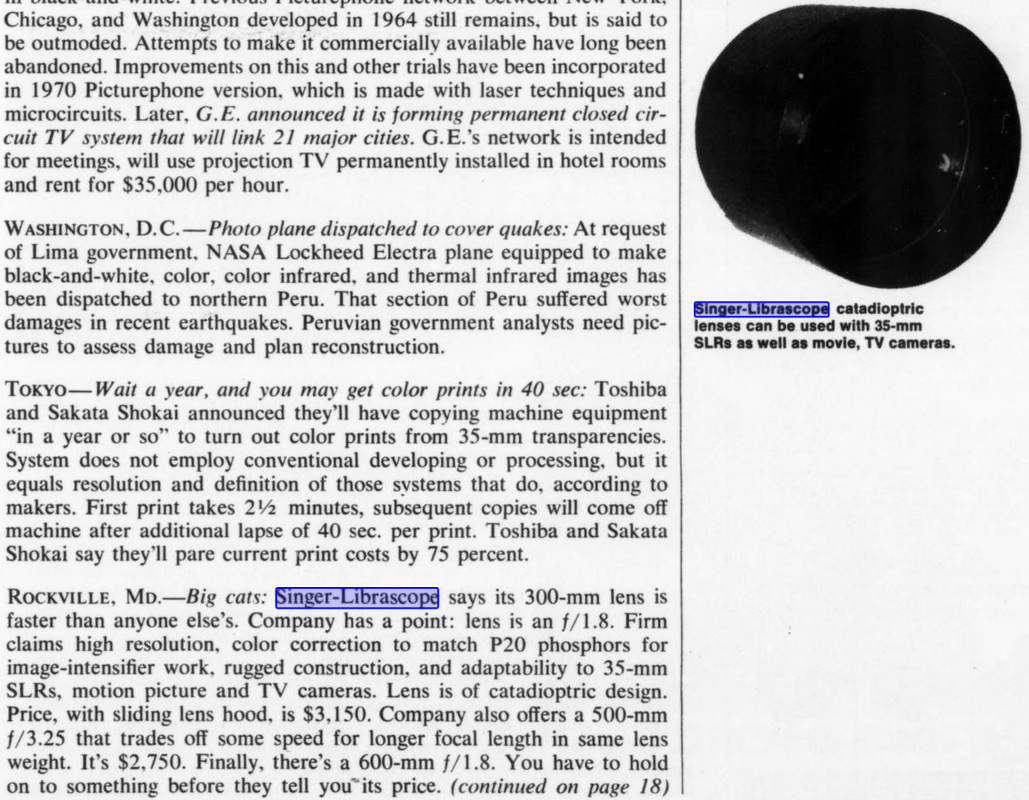
Popular Photography 1970-11: Vol 67 Iss 5 p.17
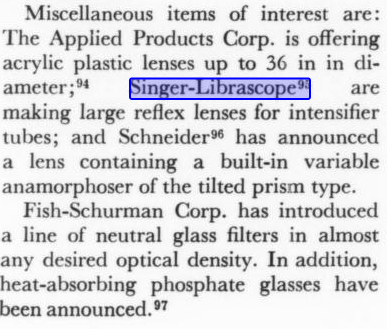
Journal of the SMPTE 1971-05: Vol 80 Iss 5 p.367 |
|
| Back to top |
|
|
xaprb
Joined: 28 Jan 2021
Posts: 180
|
Posted: Fri Jun 10, 2022 2:37 pm Post subject: |
|
Posted: Fri Jun 10, 2022 2:37 pm Post subject: |
|
|
xaprb wrote:
I found that Evernote archive via https://www.librascopememories.com/ |
|
| Back to top |
|
|
xaprb
Joined: 28 Jan 2021
Posts: 180
|
Posted: Fri Jun 10, 2022 6:45 pm Post subject: |
|
Posted: Fri Jun 10, 2022 6:45 pm Post subject: |
|
|
xaprb wrote:
Here’s a brochure for the 600mm f1.8
https://librascopememories.com/Librascope_Memories/Product_Literature_files/600mm%20Lens%20-%201973.pdf |
|
| Back to top |
|
|
eggplant
Joined: 27 May 2020
Posts: 517
|
Posted: Fri Jun 10, 2022 6:55 pm Post subject: |
|
Posted: Fri Jun 10, 2022 6:55 pm Post subject: |
|
|
eggplant wrote:
Ahhh didn't navigate to that part... very interesting. This website seems very well documented.
Will have to see if they patented anything next... |
|
| Back to top |
|
|
europanorama
Joined: 27 May 2012
Posts: 128
|
Posted: Sat Oct 15, 2022 2:11 am Post subject: AF-go Contax AX even Vivitar 600/8 is working since Catad. |
|
Posted: Sat Oct 15, 2022 2:11 am Post subject: AF-go Contax AX even Vivitar 600/8 is working since Catad. |
|
|
europanorama wrote:
For AF use it on Contax AX even slow F8 vivitar 600/8 cat is working since catadioptic. i tested it.
_________________
mpa |
|
| Back to top |
|
|
eggplant
Joined: 27 May 2020
Posts: 517
|
Posted: Sat Oct 15, 2022 9:47 am Post subject: |
|
Posted: Sat Oct 15, 2022 9:47 am Post subject: |
|
|
eggplant wrote:
What do you mean by "since catadioptric"? Do you mean that optical design has something to do with autofocus capability?
I have some ideas but won't put words in your mouth.
_________________
UK |
|
| Back to top |
|
|
|
|
 Español
 中文
 Magyar
 Русский
 Deutsch
 日本語
 Français



