| View previous topic :: View next topic |
| Author |
Message |
D1N0 


Joined: 07 Aug 2012
Posts: 2726
|
 Posted: Sun Dec 19, 2021 4:05 pm Post subject: |
|
Posted: Sun Dec 19, 2021 4:05 pm Post subject: |
|
|
D1N0 wrote:
| caspert79 wrote: |
| D1N0 wrote: |
| caspert79 wrote: |
The older Vivitar's serial numbers don't refer to specific manufacturers. So it's an older lens for sure. |
The use of plastics and the fact it is an auto-aperture lens points to a newer lens. Those pre-convention Vivitars tend to be preset lenses. If you follow the Vivitar serial number convention this is likely from 1978. |
Are you sure there are plastics? Also, the font on the front ring looks very old fashioned. Also no multicoating? |
Vivitar always used that font for the brand name also on lenses from the eighties. Not all lenses in the late seventies and early eighties had multi-coating. The samples I can see seem to have a single layer of blueish coating. Here are a Pentor and Vivitar side by side:
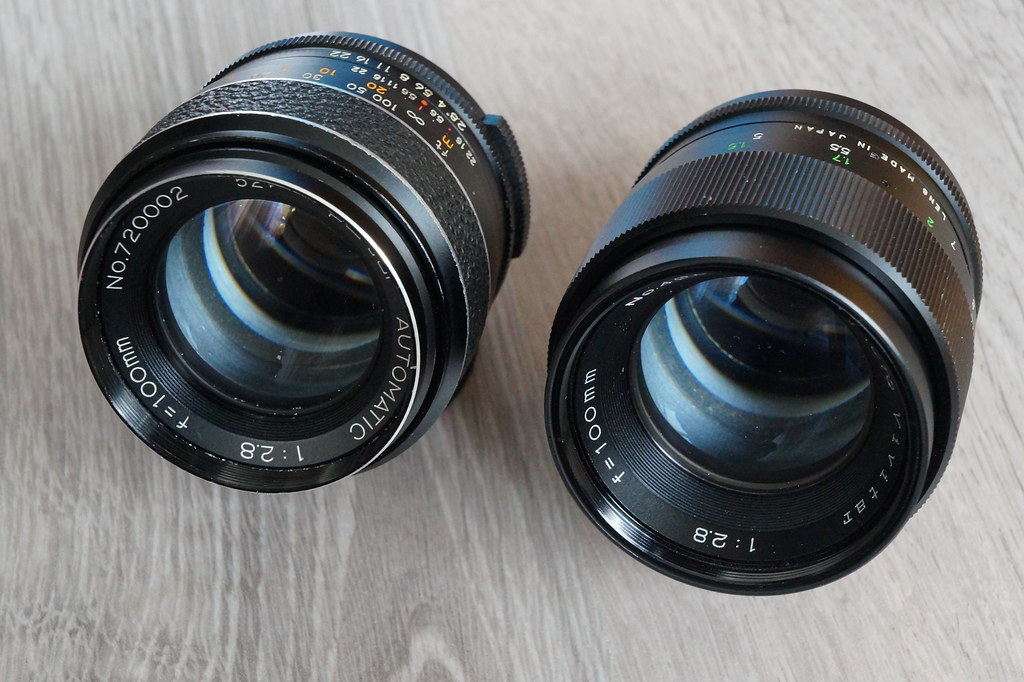 2 x 100mm by René Maly, on Flickr
_________________
pentaxian |
|
| Back to top |
|
 |
caspert79

Joined: 31 Oct 2010
Posts: 3916
Location: The Netherlands
|
Posted: Sun Dec 19, 2021 4:11 pm Post subject: |
|
Posted: Sun Dec 19, 2021 4:11 pm Post subject: |
|
|
caspert79 wrote:
Could it be Tokina? |
|
| Back to top |
|
|
D1N0
Joined: 07 Aug 2012
Posts: 2726
|
Posted: Sun Dec 19, 2021 4:18 pm Post subject: |
|
Posted: Sun Dec 19, 2021 4:18 pm Post subject: |
|
|
D1N0 wrote:
No Tokina is different. I think Sun

_________________
pentaxian |
|
| Back to top |
|
|
caspert79
Joined: 31 Oct 2010
Posts: 3916
Location: The Netherlands
|
Posted: Mon Dec 20, 2021 7:53 am Post subject: |
|
Posted: Mon Dec 20, 2021 7:53 am Post subject: |
|
|
caspert79 wrote:
| D1N0 wrote: |
No Tokina is different. I think Sun
|
Sorry, I was not paying attention. Until now I'm quite pleased with any 100mm lens I've used, at least bokeh-wise. How's the Vivitar? |
|
| Back to top |
|
|
D1N0
Joined: 07 Aug 2012
Posts: 2726
|
Posted: Mon Dec 20, 2021 11:01 am Post subject: |
|
Posted: Mon Dec 20, 2021 11:01 am Post subject: |
|
|
D1N0 wrote:
Vivitar had both Tokina and Sun 100/2.8
Here's the Tokina (not mine I just have a Pentax-m and Pentacon 100/2. : https://www.flickr.com/photos/bart_/albums/72157623843624121/with/5214179514/
Here is a Porst album (assuming Porst only had a Sun version...): https://www.flickr.com/photos/73743163@N02/albums/72157643463537045
_________________
pentaxian |
|
| Back to top |
|
|
Phalbert

Joined: 17 May 2009
Posts: 420
Location: Namibia
|
Posted: Mon Dec 20, 2021 4:11 pm Post subject: A couple of Tamrons |
|
Posted: Mon Dec 20, 2021 4:11 pm Post subject: A couple of Tamrons |
|
|
Phalbert wrote:
I found a 80-210 / 3,8-4 and a 28-70 / 3,5-4,5 at a local cash converter. I wasn't looking for them but then, they had a look at me, so I looked closely and saw that both had the nikon AIS mount, which is impossible to find around here. And guess what? I had been looking for one. 
So I checked the price tag and Wow! 49 Namibian dollars each! Which is about US$ 3 ! SO I went for it at $6 for both... Lenses included. But these are not AIS compatible.
I don't need these lenses since I already have other to cover these ranges, but still, the 28-70 is in excellent condition without any flaw except a few tiny cosmetic things on the body. Glass and aperture and all are just fine. The tele is all fine too, but with a bit of peripheric hazing or separation on the glass and a bit of dust. All barely visible against daylight but obvious with the flashlight test.
A good deal for the adaptalls.

_________________
My wishlist: Titan or Idaho 135/1,8 Nikon Df Nikkor 105/1,8 35/1,4 85/1,4
Soligor 17/4 Komura 28/3,5 Komura 24/4
Sigma 400/5,6 mirror Tamron 350/5,6 mirror
My dream lenses: Zuiko 180/2 Prototype Zuiko 85/1,4
Zeiss CY: 55/1,2 85/1,2
Astro Berlin 250/2 Canon EF 50/1,0 85/1,2
Nikkor 105/1,4 28/1,4
My stolen stuff: Zuiko 24/2 #106874; Zuiko 35-80/2,8 #102180; Zuiko 35/2 #119168; Zuiko 90/2 macro #102858; Zuiko x1,4 converter #102019; Tamron 17/3,5 #400567; Tamron 400/4 #80407; Soligor 135/2 #17506600 Sigma 28/1,8 #1001124 |
|
| Back to top |
|
|
D1N0
Joined: 07 Aug 2012
Posts: 2726
|
Posted: Tue Dec 21, 2021 10:44 am Post subject: |
|
Posted: Tue Dec 21, 2021 10:44 am Post subject: |
|
|
D1N0 wrote:
The 80-210 is the improved version 103A over 03A but still all metal unlike the 70-210 46a successor which has a plastic zoom/focusring.
Last edited by D1N0 on Tue Dec 21, 2021 11:56 am; edited 1 time in total |
|
| Back to top |
|
|
kansalliskala

Joined: 19 Jul 2007
Posts: 5122
Location: Southern Finland countryside
Expire: 2016-12-30
|
Posted: Tue Dec 21, 2021 11:50 am Post subject: Re: A couple of Tamrons |
|
Posted: Tue Dec 21, 2021 11:50 am Post subject: Re: A couple of Tamrons |
|
|
kansalliskala wrote:
| Phalbert wrote: |
| But these are not AIS compatible. |
why not?
_________________
MF: Kodak DCS SLR/c; Samsung NX10; OM-10; Canon T50
Zuiko 28/3.5, Distagon 35/2.8; Yashica ML 50/2;
Zuiko 50/1.4; S-M-C 120/2.8; Zuiko 135/3.5; 200/5;
Tamron AD1 135/2.8, Soligor 180/3.5; Tamron AD1 300/5.6
Tamron zooms: 01A, Z-210
Yashicaflex C; Київ 4 + Юпитер 8, 11; Polaroid 100; Olympus XA; Yashica T3
Museum stuff: Certo-Phot; Tele-Edixon 135; Polaris 90-190; Asahi Bellows; Ixus IIs
Projects: Agfa Isolette III (no shutter), Canon AE-1D (no sensor),
Nikon D80 (dead), The "Peace Camera"
AF: Canon, Tokina, Sigma Video: JVC GZ-MG275E |
|
| Back to top |
|
|
Phalbert
Joined: 17 May 2009
Posts: 420
Location: Namibia
|
Posted: Tue Dec 21, 2021 3:42 pm Post subject: |
|
Posted: Tue Dec 21, 2021 3:42 pm Post subject: |
|
|
Phalbert wrote:
I mean the lenses. Older pre AIS mounts. The adaptalls are. I'm not sure. Maybe it's the D90 I'm usually using. It recognizes only the lenses with electric contacts, even older Nikkor AIS. I have to set things manually.
_________________
My wishlist: Titan or Idaho 135/1,8 Nikon Df Nikkor 105/1,8 35/1,4 85/1,4
Soligor 17/4 Komura 28/3,5 Komura 24/4
Sigma 400/5,6 mirror Tamron 350/5,6 mirror
My dream lenses: Zuiko 180/2 Prototype Zuiko 85/1,4
Zeiss CY: 55/1,2 85/1,2
Astro Berlin 250/2 Canon EF 50/1,0 85/1,2
Nikkor 105/1,4 28/1,4
My stolen stuff: Zuiko 24/2 #106874; Zuiko 35-80/2,8 #102180; Zuiko 35/2 #119168; Zuiko 90/2 macro #102858; Zuiko x1,4 converter #102019; Tamron 17/3,5 #400567; Tamron 400/4 #80407; Soligor 135/2 #17506600 Sigma 28/1,8 #1001124 |
|
| Back to top |
|
|
visualopsins

Joined: 05 Mar 2009
Posts: 11707
Location: California
Expire: 2027-07-11
|
Posted: Wed Dec 22, 2021 2:31 am Post subject: |
|
Posted: Wed Dec 22, 2021 2:31 am Post subject: |
|
|
visualopsins wrote:
Super-Multi-Coated Takumar 1:3.5 / 24 with both caps and hood and hood case
Super-Multi-Coated Takumar 1:3.5 / 28 with both caps
SMC Takumar 1:1.8 / 55 with both caps and hood
Super-Takumar 1:3.5 / 135 (model II) with both caps and hood
Super-Multi-Coated Takumar 1:4 / 200 with both caps and hood
Fujica ST-705
_________________
☮☮☮☮☮☮☮☮☮☮☮☮☮☮☮☮☮☮☮☮☮☮☮☮☮☮☮☮☮☮☮☮ like attracts like! ☮☮☮☮☮☮☮☮☮☮☮☮☮☮☮☮☮☮☮☮☮☮☮☮☮☮☮☮☮☮☮☮
Cameras: Sony ILCE-7RM2, Spotmatics II, F, and ESII, Nikon P4
Lenses:
M42 Asahi Optical Co., Takumar 1:4 f=35mm, 1:2 f=58mm (Sonnar), 1:2.4 f=58mm (Heliar), 1:2.2 f=55mm (Gaussian), 1:2.8 f=105mm (Model I), 1:2.8/105 (Model II), 1:5.6/200, Tele-Takumar 1:5.6/200, 1:6.3/300, Macro-Takumar 1:4/50, Auto-Takumar 1:2.3 f=35, 1:1.8 f=55mm, 1:2.2 f=55mm, Super-TAKUMAR 1:3.5/28 (fat), 1:2/35 (Fat), 1:1.4/50 (8-element), Super-Multi-Coated Fisheye-TAKUMAR 1:4/17, Super-Multi-Coated TAKUMAR 1:4.5/20, 1:3.5/24, 1:3.5/28, 1:2/35, 1:3.5/35, 1:1.8/85, 1:1.9/85 1:2.8/105, 1:3.5/135, 1:2.5/135 (II), 1:4/150, 1:4/200, 1:4/300, 1:4.5/500, Super-Multi-Coated Macro-TAKUMAR 1:4/50, 1:4/100, Super-Multi-Coated Bellows-TAKUMAR 1:4/100, SMC TAKUMAR 1:1.4/50, 1:1.8/55
M42 Carl Zeiss Jena Flektogon 2.4/35
Contax Carl Zeiss Vario-Sonnar T* 28-70mm F3.5-4.5
Pentax K-mount SMC PENTAX-A ZOOM 1:3.5 35~105mm, SMC PENTAX ZOOM 1:4 45~125mm
Nikon Micro-NIKKOR-P-C Auto 1:3.5 f=55mm, NIKKOR-P Auto 105mm f/2.5 Pre-AI (Sonnar), Micro-NIKKOR 105mm 1:4 AI, NIKKOR AI-S 35-135mm f/3,5-4,5
Solinon 1:5.6/18 ASPH.
Tamron SP 17mm f/3.5 (51B), Tamron SP 17mm f/3.5 (151B), SP 500mm f/8 (55BB), SP 70-210mm f/3.5 (19AH)
Vivitar 100mm 1:2.8 MC 1:1 Macro Telephoto (Kiron)
|
|
| Back to top |
|
|
kansalliskala
Joined: 19 Jul 2007
Posts: 5122
Location: Southern Finland countryside
Expire: 2016-12-30
|
Posted: Wed Dec 22, 2021 8:28 am Post subject: |
|
Posted: Wed Dec 22, 2021 8:28 am Post subject: |
|
|
kansalliskala wrote:
| visualopsins wrote: |
| Fujica ST-705 |
why?  
_________________
MF: Kodak DCS SLR/c; Samsung NX10; OM-10; Canon T50
Zuiko 28/3.5, Distagon 35/2.8; Yashica ML 50/2;
Zuiko 50/1.4; S-M-C 120/2.8; Zuiko 135/3.5; 200/5;
Tamron AD1 135/2.8, Soligor 180/3.5; Tamron AD1 300/5.6
Tamron zooms: 01A, Z-210
Yashicaflex C; Київ 4 + Юпитер 8, 11; Polaroid 100; Olympus XA; Yashica T3
Museum stuff: Certo-Phot; Tele-Edixon 135; Polaris 90-190; Asahi Bellows; Ixus IIs
Projects: Agfa Isolette III (no shutter), Canon AE-1D (no sensor),
Nikon D80 (dead), The "Peace Camera"
AF: Canon, Tokina, Sigma Video: JVC GZ-MG275E |
|
| Back to top |
|
|
D1N0
Joined: 07 Aug 2012
Posts: 2726
|
Posted: Wed Dec 22, 2021 1:43 pm Post subject: |
|
Posted: Wed Dec 22, 2021 1:43 pm Post subject: |
|
|
D1N0 wrote:
Because it had an attachment I guess :p
_________________
pentaxian |
|
| Back to top |
|
|
visualopsins
Joined: 05 Mar 2009
Posts: 11707
Location: California
Expire: 2027-07-11
|
Posted: Wed Dec 22, 2021 3:41 pm Post subject: |
|
Posted: Wed Dec 22, 2021 3:41 pm Post subject: |
|
|
visualopsins wrote:
| kansalliskala wrote: |
| visualopsins wrote: |
| Fujica ST-705 |
why? |
| D1N0 wrote: |
| Because it had an attachment I guess :p |
Bundled with lens set; free shipping.  I have some film rolls too.
_________________
☮☮☮☮☮☮☮☮☮☮☮☮☮☮☮☮☮☮☮☮☮☮☮☮☮☮☮☮☮☮☮☮ like attracts like! ☮☮☮☮☮☮☮☮☮☮☮☮☮☮☮☮☮☮☮☮☮☮☮☮☮☮☮☮☮☮☮☮
Cameras: Sony ILCE-7RM2, Spotmatics II, F, and ESII, Nikon P4
Lenses:
M42 Asahi Optical Co., Takumar 1:4 f=35mm, 1:2 f=58mm (Sonnar), 1:2.4 f=58mm (Heliar), 1:2.2 f=55mm (Gaussian), 1:2.8 f=105mm (Model I), 1:2.8/105 (Model II), 1:5.6/200, Tele-Takumar 1:5.6/200, 1:6.3/300, Macro-Takumar 1:4/50, Auto-Takumar 1:2.3 f=35, 1:1.8 f=55mm, 1:2.2 f=55mm, Super-TAKUMAR 1:3.5/28 (fat), 1:2/35 (Fat), 1:1.4/50 (8-element), Super-Multi-Coated Fisheye-TAKUMAR 1:4/17, Super-Multi-Coated TAKUMAR 1:4.5/20, 1:3.5/24, 1:3.5/28, 1:2/35, 1:3.5/35, 1:1.8/85, 1:1.9/85 1:2.8/105, 1:3.5/135, 1:2.5/135 (II), 1:4/150, 1:4/200, 1:4/300, 1:4.5/500, Super-Multi-Coated Macro-TAKUMAR 1:4/50, 1:4/100, Super-Multi-Coated Bellows-TAKUMAR 1:4/100, SMC TAKUMAR 1:1.4/50, 1:1.8/55
M42 Carl Zeiss Jena Flektogon 2.4/35
Contax Carl Zeiss Vario-Sonnar T* 28-70mm F3.5-4.5
Pentax K-mount SMC PENTAX-A ZOOM 1:3.5 35~105mm, SMC PENTAX ZOOM 1:4 45~125mm
Nikon Micro-NIKKOR-P-C Auto 1:3.5 f=55mm, NIKKOR-P Auto 105mm f/2.5 Pre-AI (Sonnar), Micro-NIKKOR 105mm 1:4 AI, NIKKOR AI-S 35-135mm f/3,5-4,5
Solinon 1:5.6/18 ASPH.
Tamron SP 17mm f/3.5 (51B), Tamron SP 17mm f/3.5 (151B), SP 500mm f/8 (55BB), SP 70-210mm f/3.5 (19AH)
Vivitar 100mm 1:2.8 MC 1:1 Macro Telephoto (Kiron)
|
|
| Back to top |
|
|
marcusBMG

Joined: 07 Dec 2012
Posts: 1392
Location: Conwy N Wales
|
Posted: Wed Dec 22, 2021 8:14 pm Post subject: |
|
Posted: Wed Dec 22, 2021 8:14 pm Post subject: |
|
|
marcusBMG wrote:
There are several variants of the nikon adaptall mount Phalbert. The original "adaptall-1" is F mount with prongs, then the later ones are described as AI and have the extra aperture connections, some have prongs and some don't. Some also have the "scoop" in the mount plate that is distinctive of the nikon AIS mount, however my understanding is that the operation of the mount is still that of an AI mount. IIRC correctly, the distinction is like that between pentax "M" and pentax "A" lenses, the closure of the iris as the aperture lever is moved is linear in the earlier mount and with area in the later ones.
From L to R:
1. adaptall -1 F mount with prongs, rimmed version
2. ditto, no upturned rim
3. 1st "AI" version
4. later version - just different lettering
5. AIS "scoop"
6. and with prongs
7. new clone mount, with and without "dandelion" chip.

_________________
pentax ME super (retired)
Pentax K3-ii; pentax K-S2; Samsung NX 20; Lumix G1 + adapters;
Adaptall collection (proliferating!) inc 200-500mm 31A, 300mm f2.8, 400mm f4.
Primes: takumar 55mm; smc 28mm, 50mm; kino/komine 28mm f2's, helios 58mm, Tamron Nestar 400mm, novoflex 400mm, Vivitar 135mm close focus, 105mm macro; Jupiter 11A; CZJ 135mm.
A classic zoom or two: VS1 (komine), Kiron Zoomlock... |
|
| Back to top |
|
|
Alun Thomas
Joined: 20 Aug 2018
Posts: 802
Location: New Zealand
|
Posted: Thu Dec 23, 2021 3:10 am Post subject: |
|
Posted: Thu Dec 23, 2021 3:10 am Post subject: |
|
|
Alun Thomas wrote:

Pretty happy to get (what I consider) a good deal on this Kallo 140 rangefinder with a Prominar 50/1.4 lens. I don't know if I'll be able to adapt it to digital very easily (at least not reversibly so it can still be used with the Kallo 140), but quite excited just the same. |
|
| Back to top |
|
|
caspert79
Joined: 31 Oct 2010
Posts: 3916
Location: The Netherlands
|
Posted: Thu Dec 23, 2021 5:15 am Post subject: |
|
Posted: Thu Dec 23, 2021 5:15 am Post subject: |
|
|
caspert79 wrote:
Hexanon 135mm f/3.2. It’s still beyond me why this lens is usually so cheap. Apparently not on many people’s radar. |
|
| Back to top |
|
|
kansalliskala
Joined: 19 Jul 2007
Posts: 5122
Location: Southern Finland countryside
Expire: 2016-12-30
|
Posted: Thu Dec 23, 2021 7:58 am Post subject: |
|
Posted: Thu Dec 23, 2021 7:58 am Post subject: |
|
|
kansalliskala wrote:
| Alun Thomas wrote: |
| I don't know if I'll be able to adapt it to digital very easily (at least not reversibly so it can still be used with the Kallo 140), but quite excited just the same. |
Please dont - buy film.
_________________
MF: Kodak DCS SLR/c; Samsung NX10; OM-10; Canon T50
Zuiko 28/3.5, Distagon 35/2.8; Yashica ML 50/2;
Zuiko 50/1.4; S-M-C 120/2.8; Zuiko 135/3.5; 200/5;
Tamron AD1 135/2.8, Soligor 180/3.5; Tamron AD1 300/5.6
Tamron zooms: 01A, Z-210
Yashicaflex C; Київ 4 + Юпитер 8, 11; Polaroid 100; Olympus XA; Yashica T3
Museum stuff: Certo-Phot; Tele-Edixon 135; Polaris 90-190; Asahi Bellows; Ixus IIs
Projects: Agfa Isolette III (no shutter), Canon AE-1D (no sensor),
Nikon D80 (dead), The "Peace Camera"
AF: Canon, Tokina, Sigma Video: JVC GZ-MG275E |
|
| Back to top |
|
|
Oldhand

Joined: 01 Apr 2013
Posts: 6016
Location: Mid North Coast NSW - Australia
|
Posted: Thu Dec 23, 2021 8:36 am Post subject: |
|
Posted: Thu Dec 23, 2021 8:36 am Post subject: |
|
|
Oldhand wrote:
| kansalliskala wrote: |
| Alun Thomas wrote: |
| I don't know if I'll be able to adapt it to digital very easily (at least not reversibly so it can still be used with the Kallo 140), but quite excited just the same. |
Please dont - buy film. |
I would like to also encourage you to use the camera with film Alun.
I think that you will enjoy it with this camera
Tom |
|
| Back to top |
|
|
KEO

Joined: 27 Sep 2018
Posts: 813
Location: USA
|
Posted: Thu Dec 23, 2021 7:40 pm Post subject: |
|
Posted: Thu Dec 23, 2021 7:40 pm Post subject: |
|
|
KEO wrote:
| caspert79 wrote: |
| Hexanon 135mm f/3.2. It’s still beyond me why this lens is usually so cheap. Apparently not on many people’s radar. |

Yes, it really is a "best buy" for old 135s. Try if for macro - it's excellent for that because it's so sharp. |
|
| Back to top |
|
|
papasito
Joined: 09 Jan 2015
Posts: 1722
|
Posted: Thu Dec 23, 2021 8:36 pm Post subject: |
|
Posted: Thu Dec 23, 2021 8:36 pm Post subject: |
|
|
papasito wrote:
| KEO wrote: |
| caspert79 wrote: |
| Hexanon 135mm f/3.2. It’s still beyond me why this lens is usually so cheap. Apparently not on many people’s radar. |
Yes, it really is a "best buy" for old 135s. Try if for macro - it's excellent for that because it's so sharp. |
Great lens. |
|
| Back to top |
|
|
visualopsins
Joined: 05 Mar 2009
Posts: 11707
Location: California
Expire: 2027-07-11
|
Posted: Thu Dec 23, 2021 10:02 pm Post subject: |
|
Posted: Thu Dec 23, 2021 10:02 pm Post subject: |
|
|
visualopsins wrote:
| papasito wrote: |
| KEO wrote: |
| caspert79 wrote: |
| Hexanon 135mm f/3.2. It’s still beyond me why this lens is usually so cheap. Apparently not on many people’s radar. |
Yes, it really is a "best buy" for old 135s. Try if for macro - it's excellent for that because it's so sharp. |
Great lens. |
Which version, black, or silver and black?
Better than S-M-C Takumar 1:3.5 / 135?
_________________
☮☮☮☮☮☮☮☮☮☮☮☮☮☮☮☮☮☮☮☮☮☮☮☮☮☮☮☮☮☮☮☮ like attracts like! ☮☮☮☮☮☮☮☮☮☮☮☮☮☮☮☮☮☮☮☮☮☮☮☮☮☮☮☮☮☮☮☮
Cameras: Sony ILCE-7RM2, Spotmatics II, F, and ESII, Nikon P4
Lenses:
M42 Asahi Optical Co., Takumar 1:4 f=35mm, 1:2 f=58mm (Sonnar), 1:2.4 f=58mm (Heliar), 1:2.2 f=55mm (Gaussian), 1:2.8 f=105mm (Model I), 1:2.8/105 (Model II), 1:5.6/200, Tele-Takumar 1:5.6/200, 1:6.3/300, Macro-Takumar 1:4/50, Auto-Takumar 1:2.3 f=35, 1:1.8 f=55mm, 1:2.2 f=55mm, Super-TAKUMAR 1:3.5/28 (fat), 1:2/35 (Fat), 1:1.4/50 (8-element), Super-Multi-Coated Fisheye-TAKUMAR 1:4/17, Super-Multi-Coated TAKUMAR 1:4.5/20, 1:3.5/24, 1:3.5/28, 1:2/35, 1:3.5/35, 1:1.8/85, 1:1.9/85 1:2.8/105, 1:3.5/135, 1:2.5/135 (II), 1:4/150, 1:4/200, 1:4/300, 1:4.5/500, Super-Multi-Coated Macro-TAKUMAR 1:4/50, 1:4/100, Super-Multi-Coated Bellows-TAKUMAR 1:4/100, SMC TAKUMAR 1:1.4/50, 1:1.8/55
M42 Carl Zeiss Jena Flektogon 2.4/35
Contax Carl Zeiss Vario-Sonnar T* 28-70mm F3.5-4.5
Pentax K-mount SMC PENTAX-A ZOOM 1:3.5 35~105mm, SMC PENTAX ZOOM 1:4 45~125mm
Nikon Micro-NIKKOR-P-C Auto 1:3.5 f=55mm, NIKKOR-P Auto 105mm f/2.5 Pre-AI (Sonnar), Micro-NIKKOR 105mm 1:4 AI, NIKKOR AI-S 35-135mm f/3,5-4,5
Solinon 1:5.6/18 ASPH.
Tamron SP 17mm f/3.5 (51B), Tamron SP 17mm f/3.5 (151B), SP 500mm f/8 (55BB), SP 70-210mm f/3.5 (19AH)
Vivitar 100mm 1:2.8 MC 1:1 Macro Telephoto (Kiron)
|
|
| Back to top |
|
|
Oldhand
Joined: 01 Apr 2013
Posts: 6016
Location: Mid North Coast NSW - Australia
|
Posted: Fri Dec 24, 2021 12:05 am Post subject: |
|
Posted: Fri Dec 24, 2021 12:05 am Post subject: |
|
|
Oldhand wrote:
| visualopsins wrote: |
| papasito wrote: |
| KEO wrote: |
| caspert79 wrote: |
| Hexanon 135mm f/3.2. It’s still beyond me why this lens is usually so cheap. Apparently not on many people’s radar. |
Yes, it really is a "best buy" for old 135s. Try if for macro - it's excellent for that because it's so sharp. |
Great lens. |
Which version, black, or silver and black?
Better than S-M-C Takumar 1:3.5 / 135? |
I don't have the SMC Takumar - only the Takumar 3.5/135 pre-set.
I would say that the lenses are both excellent, but different.
I like both.
Takumar:
#1

Hexanon:
#2
 |
|
| Back to top |
|
|
stevemark
Joined: 29 Apr 2011
Posts: 5515
Location: Switzerland
|
Posted: Fri Dec 24, 2021 12:07 am Post subject: |
|
Posted: Fri Dec 24, 2021 12:07 am Post subject: |
|
|
stevemark wrote:
| papasito wrote: |
| KEO wrote: |
| caspert79 wrote: |
| Hexanon 135mm f/3.2. It’s still beyond me why this lens is usually so cheap. Apparently not on many people’s radar. |
Yes, it really is a "best buy" for old 135s. Try if for macro - it's excellent for that because it's so sharp. |
Great lens. |
Very little CAs (for a vintage 135mm lens) when stopped down to f8 or 11:
http://www.artaphot.ch/konica-ar/lens-tests/505-135mm-ar-hexanons-f25-f32-f35
| visualopsins wrote: |
| Better than S-M-C Takumar 1:3.5 / 135? |
Interesting question - I'll compare them tomorrow (weather should be quite OK) and include a few other classical 13mm lenses such as the Canon nFD 2.8/135mm, the Leica R 2.8/135mm, the Minolta MC/MD Rokkor 2.8/135mm [4/4], the Nikkor AiS 2.8/135mm, the Olympus Zuiko 2.8/135mm, the Yashica ML 2.8/135mm and the Zeiss CY Sonnar 2.8/135mm.
S
_________________
www.artaphot.ch |
|
| Back to top |
|
|
visualopsins
Joined: 05 Mar 2009
Posts: 11707
Location: California
Expire: 2027-07-11
|
Posted: Fri Dec 24, 2021 12:55 am Post subject: |
|
Posted: Fri Dec 24, 2021 12:55 am Post subject: |
|
|
visualopsins wrote:
Thanks Tom & Steve!
I'm actually more interested in which version we're seeing, black, or silver and black?
_________________
☮☮☮☮☮☮☮☮☮☮☮☮☮☮☮☮☮☮☮☮☮☮☮☮☮☮☮☮☮☮☮☮ like attracts like! ☮☮☮☮☮☮☮☮☮☮☮☮☮☮☮☮☮☮☮☮☮☮☮☮☮☮☮☮☮☮☮☮
Cameras: Sony ILCE-7RM2, Spotmatics II, F, and ESII, Nikon P4
Lenses:
M42 Asahi Optical Co., Takumar 1:4 f=35mm, 1:2 f=58mm (Sonnar), 1:2.4 f=58mm (Heliar), 1:2.2 f=55mm (Gaussian), 1:2.8 f=105mm (Model I), 1:2.8/105 (Model II), 1:5.6/200, Tele-Takumar 1:5.6/200, 1:6.3/300, Macro-Takumar 1:4/50, Auto-Takumar 1:2.3 f=35, 1:1.8 f=55mm, 1:2.2 f=55mm, Super-TAKUMAR 1:3.5/28 (fat), 1:2/35 (Fat), 1:1.4/50 (8-element), Super-Multi-Coated Fisheye-TAKUMAR 1:4/17, Super-Multi-Coated TAKUMAR 1:4.5/20, 1:3.5/24, 1:3.5/28, 1:2/35, 1:3.5/35, 1:1.8/85, 1:1.9/85 1:2.8/105, 1:3.5/135, 1:2.5/135 (II), 1:4/150, 1:4/200, 1:4/300, 1:4.5/500, Super-Multi-Coated Macro-TAKUMAR 1:4/50, 1:4/100, Super-Multi-Coated Bellows-TAKUMAR 1:4/100, SMC TAKUMAR 1:1.4/50, 1:1.8/55
M42 Carl Zeiss Jena Flektogon 2.4/35
Contax Carl Zeiss Vario-Sonnar T* 28-70mm F3.5-4.5
Pentax K-mount SMC PENTAX-A ZOOM 1:3.5 35~105mm, SMC PENTAX ZOOM 1:4 45~125mm
Nikon Micro-NIKKOR-P-C Auto 1:3.5 f=55mm, NIKKOR-P Auto 105mm f/2.5 Pre-AI (Sonnar), Micro-NIKKOR 105mm 1:4 AI, NIKKOR AI-S 35-135mm f/3,5-4,5
Solinon 1:5.6/18 ASPH.
Tamron SP 17mm f/3.5 (51B), Tamron SP 17mm f/3.5 (151B), SP 500mm f/8 (55BB), SP 70-210mm f/3.5 (19AH)
Vivitar 100mm 1:2.8 MC 1:1 Macro Telephoto (Kiron)
|
|
| Back to top |
|
|
fiftyonepointsix
Joined: 30 Apr 2017
Posts: 294
|
Posted: Fri Dec 24, 2021 1:43 am Post subject: |
|
Posted: Fri Dec 24, 2021 1:43 am Post subject: |
|
|
fiftyonepointsix wrote:
I picked up another (my 4th) KMZ Jupiter-3 made in 1956. This has a higher serial number than any I have seen, 5604078. I've read that KMZ recomputed the J-3 in 1954 to use Russian Glass. I know that my other KMZ Jupiter-3's all use elements and fixtures that are completely interchangeable with original 5cm F1.5 Sonnars, and know they use Schott glass.
1956 ZOMZ left, very late 1956 KMZ middle, earlier 1956 KMZ right.

This one is different from all my other KMZ lenses. The rear fixture looks like the ZOMZ, my 1956 ZOMZ on the left and the latest KMZ on the right.

The new KMZ design has the threads up front and guide ring. It is not compatible with the Zeiss lens.
The Scribe marks of the KMZ lens match that of the earlier KMZ's, and the thickness of the rim is 2mm.

This matches the earlier, different design rear fixture.
The ZOMZ thickness is 2.2mm.

To really confuse things, the optical block was mounted in a mid 1970s ZOMZ focus mount that was misassembled and would not focus correctly on a Rangefinder camera. It would have worked on a Mirrorless camera.

Optically- much more field curvature than the earlier design. Center sharp. I'm still testing. It's not as good as my other KMZ lenses, and I suspect this is why KMZ handed production over to ZOMZ.
This is a lens that will probably get more use on my 1.3x crop factor M8.
Wide-Open and Close up on the M8,

Wide-Open on the M9.
 |
|
| Back to top |
|
|
|
|
 Español
 中文
 Magyar
 Русский
 Deutsch
 日本語
 Français



